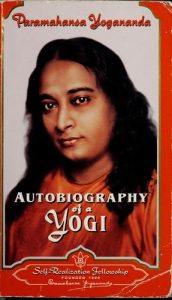
Steve Jobs reportedly read this book once a year for the last several decades of his life. It was the only book on his iPad. Copies were given to every attendee at his memorial service. When I first learned that, I remember thinking, what kind of book earns that level of devotion from someone who built Apple?
So I read it. Then I read it again. Then I understood.
What You’re Walking Into
Autobiography of a Yogi is exactly what the title says: the life story of Paramahansa Yogananda, an Indian yogi who came to America in 1920 and spent the next three decades teaching meditation and what he called the “science of Kriya Yoga.” First published in 1946, it’s been in continuous print ever since, translated into over fifty languages.
But calling it an autobiography sells it short. It’s part spiritual memoir, part travelogue, part introduction to Hindu philosophy, and part collection of miracle stories that will either shatter your materialist worldview or make you throw the book across the room. Possibly both in the same sitting.
Yogananda writes about meeting saints who could bilocate, appear in two places simultaneously. He describes a woman who hadn’t eaten in decades. He recounts his guru, Sri Yukteswar, appearing to him in bodily form after death, describing the astral planes in clinical detail. These aren’t presented as metaphors or allegories. Yogananda writes about them as factual events, witnessed firsthand.
The Chapters That Stopped Me Cold
Chapter 14, “An Experience in Cosmic Consciousness,” is the heart of this book. Yogananda describes an experience his guru triggered in him, a direct perception of the unity underlying all creation. His description is remarkably specific, not vague or flowery:
“My body became immovably rooted; breath was drawn out of my lungs as if by some huge magnet. Soul and mind instantly lost their physical bondage, and streamed out like a fluid piercing light from my every pore. The flesh was as though dead, yet in my intense awareness I knew that never before had I been fully alive.”
– Paramahansa Yogananda, Chapter 14
What struck me about this passage (and it still strikes me on every reread) is its sensory precision. This isn’t someone waving their hands about “oneness.” Yogananda describes exact physical sensations, specific shifts in perception, the quality of awareness moment by moment. Whether you believe he experienced exactly what he claims, the writing has the unmistakable texture of someone describing something real.
Chapter 12, about Yogananda’s relationship with his guru Sri Yukteswar, is the emotional core. Yukteswar is portrayed as fierce, exacting, deeply loving, and occasionally terrifying, a teacher who could read your thoughts, call you out on your self-deceptions, and somehow make you grateful for the demolition. The guru-disciple dynamic Yogananda describes will feel foreign to Western readers, but there’s something in it that transcends culture, the longing for a teacher who sees you completely and loves you anyway.
And then there’s Chapter 43, where Yogananda describes Sri Yukteswar appearing to him after death, in a physical body, in a hotel room in Mumbai. He spends pages describing what Yukteswar told him about the afterlife, the astral and causal planes, the nature of resurrection, the mechanics of reincarnation. It reads like science fiction written by someone who isn’t writing fiction. You either put the book down here or you go deeper than you planned.
Why This Book Survives Across Decades
I’ve thought a lot about why Autobiography of a Yogi endures while thousands of spiritual books from the same era have disappeared. I think it comes down to voice. Yogananda is genuinely funny, self-deprecating, and honest about his own struggles in a way that most spiritual teachers aren’t. He writes about trying to run away from his guru. He admits to being afraid, confused, and stubborn. He tells stories against himself.
There’s a scene early in the book where young Mukunda (Yogananda’s birth name) decides to run away to the Himalayas to find God, and his older brother intercepts him at the train station. Yogananda describes his indignation, his petulance, his absolute certainty that he knew better, and he does it with such gentle humor toward his younger self that you can’t help laughing. This is a spiritual master who hasn’t airbrushed his humanity out of the picture.
“Seeds of past karma cannot germinate if they are roasted in the divine fires of wisdom.”
– Paramahansa Yogananda, Chapter 16
The Uncomfortable Parts
I’m not going to pretend this is a flawless book. The miracle stories are a genuine challenge. Yogananda describes events that violate every known law of physics, levitation, teleportation, materialization of objects, resurrection. He presents them without skepticism, without alternative explanation, without any acknowledgment that the reader might find them difficult to accept.
For some readers, this is the point. The miracles are meant to expand your sense of what’s possible, to crack open the materialist cage. For others, they’re a dealbreaker. I’ve recommended this book to friends who bounced off it entirely because they couldn’t get past the supernatural claims. That’s a legitimate response, and I respect it.
The book is also long (over 500 pages in most editions) and the middle section, where Yogananda describes various saints and their miraculous powers, can feel repetitive. The pacing isn’t always tight. Some chapters feel like detours from the main narrative.
And Yogananda’s attitude toward women, while better than many of his contemporaries, still carries traces of the cultural context. Women appear mostly as mothers, devotees, or saints. The complex inner life of female spiritual seekers doesn’t get much airtime. It’s a product of its era, but it’s worth noting.
What It Did to Me Personally
I’ll be direct: this book changed the direction of my spiritual life. Before reading it, I was interested in meditation as a stress-reduction tool, basically a mental health practice with some vaguely spiritual overtones. After reading it, I understood that meditation traditions are pointing at something much larger than stress relief. Yogananda’s descriptions of cosmic consciousness, of the deeper purposes of human life, of the relationship between guru and student. They didn’t just inform me. They ignited something.
I started a regular meditation practice within a week of finishing the book. That was years ago. I’m still sitting every morning. I trace it directly back to Chapter 14 and the feeling it gave me. Not of understanding, exactly, but of recognition. Like remembering something I’d always known but had somehow forgotten.
A Practice Inspired by This Book
Yogananda taught a technique he called Hong-Sau, a simple concentration practice that anyone can do. Here’s a basic version:
Sit comfortably with your spine straight and eyes closed. Take a few deep breaths to settle. Then let your breath return to its natural rhythm, don’t control it. As you inhale naturally, mentally say “Hong.” As you exhale, mentally say “Sau” (rhymes with “saw”). Don’t force the breath to match the words, let the words follow the breath. If your attention wanders, gently return to the breath and the words.
Start with ten minutes. Do it daily for two weeks. What you’ll likely notice first is how wild your mind is, and then, gradually, moments of stillness between thoughts that feel like stepping into open sky. That’s the beginning of what Yogananda spent his life teaching.
Who This Is For
Read this if you’re hungry for something deeper than self-help spirituality. Read it if you’ve sensed there’s more to meditation than apps and breathing exercises. Read it if you want to encounter a voice that’s simultaneously ancient and startlingly alive.
Skip it (or at least wait) if you need empirical evidence before engaging with spiritual ideas. This book isn’t going to meet you on those terms. It asks you to hold open the possibility that reality is much stranger and more beautiful than consensus materialism allows. If you can do that, even tentatively, the book will reward you in ways I’m still discovering years later.
I understand now why Jobs read it every year. Some books you finish. This one finishes you.
Enjoyed this review?
Buy Autobiography of a Yogi on Amazon As an affiliate, we may earn a small commission at no extra cost to you.