There’s a particular kind of frustration that comes from reading a spiritual teacher’s autobiography and wanting more, more teaching, more explanation, more of that voice. After finishing Autobiography of a Yogi, I felt like I’d met someone extraordinary at a dinner party but the evening ended too soon. I had a sense of who Yogananda was, but not enough of what he actually taught day to day, to real people, in real rooms.
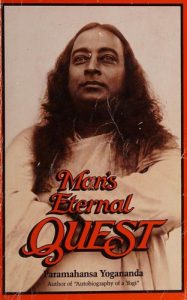
Man’s Eternal Quest fills that gap. Published posthumously in 1975, it collects talks and informal lectures Yogananda gave to students and followers over decades. These aren’t polished essays, they’re a teacher thinking out loud, responding to questions, riffing on topics from meditation technique to the nature of death to how to eat properly. The result is messy, sprawling, repetitive, and absolutely essential for anyone who wants to understand Yogananda beyond the autobiography.
What You’ll Find Inside
The book is organized thematically, not chronologically. Sections cover meditation, the nature of God, human relationships, health, the afterlife, and practical spiritual living. Each section contains multiple talks, ranging from a few pages to twenty or more.
The tone is radically different from the autobiography. Where that book was literary and carefully crafted, these talks are conversational, sometimes rambling, often funny. Yogananda had a gift for finding the absurd in human nature, and he uses humor throughout, usually to make a point that cuts deeper than a straight lecture would.
He’ll be discussing cosmic consciousness and then suddenly say something about how Americans eat too fast, or how worrying about the stock market is a form of spiritual blindness, and the room clearly laughs (you can almost hear it), and then he’ll pivot back to the eternal with a sentence that stops you cold.
“Most people try to correct the world. But the world is only a reflection. The real correction has to be done within.”
– Paramahansa Yogananda, “Making the Lord Your Employer”
The Talks That Hit Hardest
“The Art of Getting Along With Others” surprised me. I expected generic spiritual advice about being kind. Instead, Yogananda delivered a psychologically sophisticated analysis of why human relationships fail. He talked about projection, seeing your own faults in others. He talked about the difference between sentimentality and real love. He said something that I wrote down and taped to my bathroom mirror: real love means wanting the other person’s highest good, even when it’s inconvenient for you.
“Ridding the Consciousness of Worry” is the talk I recommend most to friends who are spiraling. Yogananda’s approach to worry is practical and immediate: he argues that worry is a habit of imagination, and like any habit, it can be broken by replacing it with a stronger one. His suggested replacement? Active faith. Not passive hope, but a deliberate decision to imagine the best outcome with the same intensity you usually imagine the worst.
“How to Be a Smile Millionaire” sounds like a terrible self-help seminar, but the talk itself is surprisingly deep. Yogananda connects genuine joy (not the performed kind, but the kind that bubbles up from a quiet mind) to spiritual realization. He argues that lasting happiness isn’t found through circumstances but through direct contact with what he calls the inner bliss of the soul. And then he gives concrete meditation instructions for accessing it.
“You must not let your life run in the ordinary way; do something that nobody else has done, something that will dazzle the world. Show that God’s creative principle works in you.”
– Paramahansa Yogananda, “Be an Angel of Peace”
The Meditation Instructions
Scattered throughout the book are meditation instructions of varying specificity. Some are brief, “sit quietly and concentrate at the point between the eyebrows.” Others are more detailed, describing breathing techniques, visualization practices, and methods for withdrawing attention from the body.
The most valuable instruction, for me, was Yogananda’s emphasis on what he calls “going deeper.” He describes meditation not as a relaxation technique but as a systematic withdrawal of consciousness from the external world, moving through layers of thought, emotion, and sensation until you reach a state of pure awareness. He likens it to diving, each session takes you a little deeper, and the treasures are at the bottom.
This framework completely changed my meditation practice. I’d been treating meditation as a surface activity, watching thoughts, noting sensations, staying present. Yogananda’s talks made me realize I was swimming in the shallows. The real practice was about depth, about pressing past the comfortable layers into silence.
Where the Book Struggles
At over 500 pages, Man’s Eternal Quest is too long. Because these are separate talks compiled posthumously, there’s significant repetition. Yogananda makes the same points about meditation, diet, and willpower across multiple talks, sometimes in nearly identical language. A judicious editor would’ve cut a hundred pages.
The organizational structure is also questionable. Grouping talks thematically makes intellectual sense, but it means you might read five talks about meditation back-to-back, each covering similar ground. A chronological arrangement would’ve shown Yogananda’s development over time and provided more variety.
Some of the health advice is dated and potentially harmful. Yogananda advocates for fasting, specific dietary restrictions, and physical practices that aren’t supported by modern medical understanding. He occasionally makes claims about curing diseases through spiritual practice alone. This material should be approached with the same historical awareness you’d bring to any mid-century health advice, interesting as a window into the era, not reliable as medical guidance.
And the devotional tone, while sincere, can be intense. Yogananda frequently breaks into prayer or ecstatic descriptions of divine love mid-lecture. If you’re drawn to devotional spirituality, this is beautiful. If you’re more analytically inclined, it can feel like the teacher keeps going off-script.
A Practice Inspired by This Book
Yogananda’s “energization exercises” are mentioned throughout these talks as a preliminary to meditation. Here’s a simplified version of the core principle:
Stand with your feet shoulder-width apart. Tense your entire body (every muscle, gently but firmly) while inhaling slowly. Hold for a few seconds. Then relax completely while exhaling, letting tension drain like water. Repeat three times.
Then bring your attention to one part of your body, say, your right hand. Tense just that hand while sending conscious energy to it. Hold, then release. Move systematically through your body: arms, shoulders, chest, abdomen, legs, feet, face.
The purpose isn’t physical exercise, it’s learning to direct energy with will. Yogananda taught that the ability to consciously tense and relax specific body parts develops willpower and body awareness that directly enhance meditation. Do this for five minutes before sitting, and notice whether your meditation changes quality. In my experience, the difference is immediate and significant.
The Verdict
Man’s Eternal Quest isn’t a book you read cover to cover. It’s a book you live with, dipping in, reading a talk or two, letting them settle, coming back when you need guidance on a specific topic. Treated as a reference and companion rather than a linear read, it’s one of the richest collections of practical spiritual wisdom I’ve encountered.
It won’t replace the Autobiography as your entry point into Yogananda. But if you’ve read the Autobiography and want to know what it would’ve been like to sit in a room with this man and listen to him teach, this is as close as you’ll get. Despite its flaws (the length, the repetition, the occasionally dated advice) the voice that comes through is unmistakably alive, warm, and wise. That voice alone is worth the price of the book.
Enjoyed this review?
Buy Man's Eternal Quest on Amazon As an affiliate, we may earn a small commission at no extra cost to you.