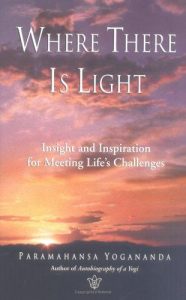
Some books you read cover to cover. Where There Is Light isn’t one of them, and I mean that as a compliment.
I’ve kept this book on my nightstand for over two years. I don’t read it sequentially. I open it when I need something, guidance about a decision, comfort during a rough week, clarity when my mind is spinning. It never fails to deliver a passage that speaks directly to whatever I’m wrestling with, which is either a sign of spiritual attunement or a sign that Yogananda covered so many topics that something relevant is always within reach. Probably both.
What This Book Actually Is
Where There Is Light is a curated anthology of Yogananda’s teachings, compiled by Self-Realization Fellowship and published in 1988. Unlike Man’s Eternal Quest and The Divine Romance, which reproduce complete talks, this book extracts passages and short selections from across Yogananda’s entire body of work (books, lectures, personal letters, private conversations) and organizes them by topic.
The topics are practical and wide-ranging: overcoming fear, finding your purpose, dealing with difficult people, understanding suffering, building willpower, deepening meditation, navigating relationships, and facing death. Each section is relatively short (often just a few pages) making the book ideal for quick consultation rather than extended reading.
Think of it as a reference manual for the inner life, organized by the problems you’re most likely to encounter.
“You must not allow your life to unfold without conscious effort. More than that, you must direct your consciousness toward a definite goal. Your will must be exercised not merely to make a living, but to make a life.”
– Paramahansa Yogananda, “Success and Happiness”
The Sections I Return To
The section on worry and anxiety has been my most-visited. Yogananda’s approach is both spiritual and pragmatic. He doesn’t just say “trust God and stop worrying.” He offers a framework: distinguish between problems you can act on and problems you can’t. For the first, take action immediately and stop rehearsing the worry. For the second, consciously hand them to what he calls “the Divine Power” and redirect your attention.
What makes this advice stick, when similar advice from a dozen other sources hasn’t, is Yogananda’s tone. He doesn’t lecture from above. He speaks as someone who struggled with the same human tendencies and found his way through them. There’s a passage where he admits to periods of deep discouragement, even after years of spiritual practice, that made me exhale with relief. If Yogananda got discouraged, maybe my own dark moments aren’t a sign of failure.
The section on relationships is equally strong. Yogananda distinguishes between attachment and love with precision I haven’t found elsewhere. Attachment, he says, clings, it grasps the other person as a source of your own happiness and panics when they pull away. Love radiates, it wishes for the other’s highest good regardless of personal cost. Most relationship problems, he argues, stem from confusing these two things.
The section on death is the one I avoided for months and then needed desperately when a friend was diagnosed with a terminal illness. Yogananda speaks about death with such calm certainty (as a transition, not an ending; as a graduation, not a punishment) that reading his words while sitting in a hospital waiting room was the closest thing to peace I found during that period.
“Be afraid of nothing. Hating none, giving love to all, feeling the love of God, seeing His presence in everyone, and having but one desire (for His constant presence in the temple of your consciousness) that is the way to live in this world.”
– Paramahansa Yogananda, “Removing All Sorrow and Suffering”
The Format’s Strengths and Weaknesses
The anthology format is both the book’s greatest asset and its limitation. On the positive side, it makes Yogananda’s vast body of work accessible in a single volume. You don’t need to read six books to find his thoughts on a specific topic, it’s all indexed here. The brevity of each section means you can absorb something meaningful in five minutes, which is realistic for people with demanding lives.
On the negative side, the excerpted format means you lose context. A passage that was part of a longer, nuanced discussion gets presented in isolation, sometimes making it sound more absolute than it was originally intended. You also miss the conversational flow of Yogananda’s talks, the humor, the digressions, the moments of spontaneous wisdom that emerge when a teacher is riffing freely.
And because the selections were curated by Self-Realization Fellowship, there’s an institutional filter at work. The passages chosen tend to present Yogananda at his most polished, most orthodox, most aligned with the organization’s message. His wilder, more provocative, more personally vulnerable moments are less represented here than in the raw talk collections.
How It Compares to the Talk Collections
If Man’s Eternal Quest is like attending Yogananda’s lectures, Where There Is Light is like reading the highlighted passages your wisest friend marked in those lectures. You get the gold without the dross. But you also miss the context that makes the gold gleam.
For a newcomer to Yogananda who isn’t ready for the 500+ page talk collections, this is an excellent entry point (after the Autobiography, which should always come first). For someone who’s already deep into his work, it’s a useful reference but not essential, you’ve likely already encountered these passages in their original settings.
A Practice Inspired by This Book
Yogananda repeatedly emphasizes what he calls “bibliomancy”, the practice of opening a spiritual text at random and reading whatever passage appears as guidance for the day. Here’s how I’ve formalized it with this book:
Each morning, before checking your phone, hold Where There Is Light (or any spiritual text that resonates with you). Close your eyes. Bring to mind whatever challenge or question is most alive for you today. Hold it lightly, don’t analyze, just feel it. Then open the book at random and read the first passage your eyes land on.
Don’t force a connection. Sometimes the passage will speak directly to your situation. Sometimes it won’t seem related at all. In those cases, sit with it anyway, often the relevance reveals itself later in the day, when a conversation or situation echoes what you read that morning.
I’ve done this almost daily for two years. The hit rate (passages that feel directly, almost eerily relevant) is higher than chance would suggest. Whether that’s genuine guidance from a deeper intelligence or a function of Yogananda covering enough topics that something always fits, I can’t say. But the practice itself creates a contemplative container for the day that consistently improves how I navigate whatever comes.
The Honest Take
Four stars. It’s not a masterwork in the way the Autobiography is. It’s not as emotionally powerful as The Divine Romance. It doesn’t have the sustained teaching depth of Man’s Eternal Quest. But it does something none of those books do: it makes Yogananda’s wisdom accessible in the stolen minutes of a busy life. And for most of us (living in the real world, managing jobs and families and obligations) accessible wisdom is more valuable than profound wisdom we never have time to reach.
Keep it by your bed. Open it when you need it. Trust that you’ll find what you need. Two years in, it hasn’t let me down yet.
Enjoyed this review?
Buy Where There Is Light on Amazon As an affiliate, we may earn a small commission at no extra cost to you.