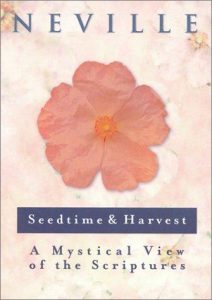
Of all Neville Goddard’s books, Seedtime and Harvest is the one I almost quit, and the one I’m most grateful I didn’t. The first twenty pages are dense, abstract, and heavy on biblical symbolism. I put it down twice. When I finally pushed through, somewhere around Chapter 3, something clicked, and the rest of the book poured through me like water finding a channel.
This is Neville’s attempt to reinterpret the Golden Rule (“Do unto others as you would have them do unto you”) not as a moral commandment but as a statement about how consciousness actually works. The result is a book that’s part philosophy, part practical manual, and part spiritual revelation. It’s uneven, occasionally brilliant, and unlike anything else in his catalog.
The Golden Rule as a Law of Mind
Here’s Neville’s central insight, and it took me several readings to fully absorb it: when you imagine something about another person, you’re not just thinking about them. You’re impressing that imagined state on your own consciousness, which then reflects it back into your experience. Imagine someone as hostile, and you’ll encounter hostility. Not because you “manifested” their behavior, but because your consciousness can only show you what it contains.
Therefore, “do unto others as you would have them do unto you” isn’t moral advice. It’s a description of a psychological law. Whatever you imagine about others, you experience. Whatever mental treatment you give someone, you give yourself. The Golden Rule is the law of imagination stated in practical terms.
“What you do to others, you do to yourself. If you imagine that another is in need, you plant that seed in yourself. If you imagine that another is wealthy and free, you plant that seed in yourself. There is no other.”
– Neville Goddard, Chapter 4
This rearranged my understanding of Neville’s entire body of work. Suddenly, the “assume the feeling of the wish fulfilled” technique wasn’t just about getting things for yourself. It was about the recognition that your imagination is a field (seedtime and harvest) and everything you plant in it, you eventually reap. Including what you imagine about other people.
The Parable Framework
Neville structures much of the book around biblical parables, reinterpreted through his lens of consciousness. The parable of the sower becomes an instruction on how imagination “sows” states of consciousness. The parable of the wheat and tares becomes a teaching on why conflicting beliefs (wheat and tares growing together) produce mixed results. The harvest imagery throughout becomes a metaphor for the time delay between imaginal act and physical manifestation.
If you enjoy this kind of interpretive work, these chapters are rich and rewarding. Neville reads the Bible like a code, and his decryptions (whatever you think of their accuracy) are internally consistent and thought-provoking. He makes you see familiar stories in completely new ways.
But if biblical interpretation isn’t your thing, these chapters will feel like a slog. There’s no way around it, Seedtime and Harvest is deeply, unapologetically scriptural. More so than Feeling Is the Secret, more so than Awakened Imagination. The Bible isn’t a reference point here; it’s the primary text.
The Practical Breakthrough
Chapter 5 contains a practice that changed how I relate to the people in my life. Neville suggests that before each significant interaction (a meeting, a phone call, a dinner) you spend a few moments imagining the encounter going beautifully. Not manipulating the other person’s behavior, but assuming the best version of them, the most harmonious version of the interaction, and entering the situation with that feeling already established.
I started doing this before every work meeting, every call with family members, every conversation I’d normally approach with dread. The results were so consistent that I now consider it one of the most valuable practices I’ve learned from any spiritual book. Conversations that I’d imagined going well tended to go well. Relationships I’d been mentally rehearsing as difficult started becoming easier. The causation is debatable (am I changing reality or just showing up with better energy?) but the practical difference is zero.
“Assume the feeling of your wish fulfilled and observe the route that your attention follows. By watching the mental activity that takes place within yourself, you learn the law of your own mind.”
– Neville Goddard, Chapter 6
The Sections That Dragged
Chapters 1 and 2 are the weakest in the book. They’re abstract, circular, and spend too long establishing the framework before giving you anything to do with it. Neville’s writing in these early chapters lacks the precision of his best work, sentences run long, metaphors pile up, and the central point gets buried under layers of scriptural reference.
I genuinely believe you could start this book at Chapter 3 without losing anything essential. The first two chapters work better as a review after you’ve read the whole book and want to deepen your understanding of the framework.
There’s also a recurring issue with Neville’s absolutism. He states his principles as though they admit no exceptions. “Imagination creates reality”, full stop, no caveats. There’s a power in that certainty, but there’s also a brittleness. Life is messy, and a teaching that doesn’t acknowledge messiness can feel disconnected from the actual experience of trying to apply it.
The Harvest Metaphor and Patience
One thing this book does better than any other Neville work is address timing. The “harvest” metaphor gives Neville a framework for talking about why manifestations don’t always appear immediately. Seeds take time to grow. The interval between planting (the imaginal act) and harvest (the physical manifestation) varies. Doubt and impatience during this interval are like digging up the seeds to check if they’re growing, counterproductive and often destructive.
This was exactly what I needed to hear when I first read it. I’d been practicing Neville’s techniques for months and getting impatient with the timeline. Seedtime and Harvest gave me a frame for understanding the delay that wasn’t “you’re doing it wrong”. It was “you planted the seed; now tend the garden and wait.” That shift from anxious expectation to patient tending made an immediate difference in both my practice and my peace of mind.
A Practice Inspired by This Book
Try Neville’s “imagine for others” practice for two weeks:
Each day, choose one person in your life and spend two minutes imagining something wonderful happening for them. Not vaguely, specifically. See them receiving good news, landing an opportunity, laughing with joy. Feel genuinely happy for them. Make it as real and vivid as you’d make any visualization for yourself.
Pay attention to two things over the two weeks: first, whether your relationship with that person shifts. Second, whether anything corresponding to what you imagined for them shows up in your own life. According to Neville’s thesis, it should, because what you imagine for others, you plant in your own consciousness.
In my experience, this practice produces two reliable results. Relationships become warmer, often without any external change in behavior. And opportunities in the area you imagined for others tend to appear in your own life, often from unexpected directions. Whether this validates Neville’s metaphysics or simply reflects the psychological benefits of goodwill, the practice itself is worth doing.
Final Assessment
Seedtime and Harvest isn’t the Neville book I’d recommend first, second, or even third. The barrier to entry is too high, the biblical content too dense, and the early chapters too abstract. But for readers who’ve already absorbed Neville’s core teachings and want to understand the relational and ethical dimensions of his work, this is essential reading.
The Golden Rule insight alone (that what you imagine about others you do to yourself) is worth the price of admission. It transformed “do unto others” from a guilt-inducing moral command into a practical strategy for creating a better experience of reality. And in a body of work known for audacious reinterpretation, that might be Neville’s most audacious (and most beautiful) claim of all.
Enjoyed this review?
Buy Seedtime and Harvest on Amazon As an affiliate, we may earn a small commission at no extra cost to you.