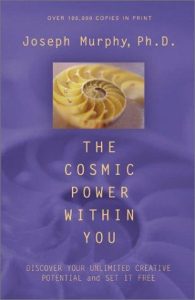
Here’s the thing about being a Joseph Murphy completist: eventually you start reading the B-sides. The Cosmic Power Within You is firmly in that category. Not a bad book, but a book that makes you wonder why it exists when The Power of Your Subconscious Mind already exists and says everything this one says, only better.
I read it because I’d hit a plateau with Murphy’s main work and hoped a less-known title would offer a fresh angle. What I found was about 30% fresh material, 50% rephrased greatest hits, and 20% filler that even Murphy’s warmth and sincerity couldn’t fully redeem. But that 30%. I need to talk about that 30%, because it’s genuinely valuable.
What Murphy’s Going For
The premise is familiar to anyone who’s read Murphy: there’s a power within your subconscious mind that’s connected to Infinite Intelligence, and by learning to direct it consciously, you can transform your health, finances, relationships, and inner life. Murphy calls this power “cosmic” here, giving it a slightly more expansive frame than his usual “subconscious mind” language, suggesting not just a personal psychological mechanism but a universal force that operates through individual consciousness.
Whether this distinction is meaningful or just marketing depends on how you read it. Murphy doesn’t develop the “cosmic” dimension rigorously. He gestures at it, your subconscious is connected to the intelligence of the universe, therefore its power is cosmic in scope. But he doesn’t explore what that connection actually entails or how it differs from ordinary subconscious operation. It reads more like a vocabulary upgrade than a conceptual one.
“The cosmic power within you is responsive to your thought. What you decree and feel as true, it will bring to pass. Decree riches, and riches will be yours. Decree health, and health will follow. The power knows no limit except the limits of your belief.”
– Joseph Murphy, Chapter 3
The Fresh Material That Earns Its Keep
Chapter 8, on what Murphy calls “the law of reversed effort,” is worth the price of the book. Murphy explains why trying harder often produces worse results: why straining to fall asleep keeps you awake, why desperately wanting a relationship pushes people away, why grasping at money seems to repel it. His explanation: the subconscious interprets effort as a signal of absence. When you try hard to get something, you’re impressing on your subconscious the feeling of not having it, which the subconscious then faithfully reproduces.
The solution Murphy proposes is effortless assumption, shifting from “I need to make this happen” to “this is already so.” Not passivity, but a different quality of engagement. Relaxed confidence instead of anxious striving. It’s a subtle distinction, but in practice, it makes a huge difference. I recognized my own pattern in Murphy’s description, the harder I pushed for certain goals, the more elusive they became. When I relaxed into the assumption of already having them, things started shifting.
Chapter 12, on forgiveness, is also strong. Murphy frames forgiveness not as a moral duty but as a mental hygiene practice. Holding resentment, he argues, is like drinking poison and expecting the other person to get sick, a metaphor that’s become commonplace but which Murphy articulates with particular clarity here. His forgiveness technique involves imagining the person who wronged you as surrounded by light and wishing them well, repeatedly, until the emotional charge dissolves. It’s simple, it’s effective, and it’s the most psychologically sound practice in the book.
The Greatest Hits You’ve Already Heard
Most of the book covers territory Murphy has explored before. The subconscious as creative mechanism? Covered extensively in The Power of Your Subconscious Mind. Healing through directed belief? Same. Prosperity consciousness? Same. Using the drowsy state before sleep to impress new beliefs? Same, same, same.
Murphy’s restatements aren’t identical to his earlier versions, he uses different anecdotes, slightly different language, occasionally a different angle. But if you’ve read his major work, you’ll spend much of this book nodding along rather than being surprised. It’s the musical equivalent of a greatest hits album with minor remix variations: pleasant but not essential.
“You do not force or coerce your subconscious mind. You activate it by relaxation, by feeling, by gentle persuasion. Think of it as a garden. You do not shout at seeds to make them grow. You plant them, water them, and trust the process.”
– Joseph Murphy, Chapter 6
That’s a fine quote, and I like the garden metaphor (Murphy loves it too. It appears in nearly every one of his books). But there’s nothing here that advances beyond what he’s already established. If you’re keeping score, this is approximately the ninth time Murphy has compared the subconscious to soil across his bibliography.
The Weaknesses
Beyond the repetition, the book suffers from Murphy’s perennial blind spots. His prosperity teaching assumes a level playing field that doesn’t exist. His healing claims overstate the power of positive thinking relative to medical intervention. His anecdotes are unverifiable and suspiciously tidy, problems arise, techniques are applied, problems vanish, usually within days or weeks.
The writing is also uneven. Some chapters read with Murphy’s characteristic warmth and clarity. Others feel rushed, as if he was meeting a publishing deadline rather than following an inspiration. The book lacks the structural coherence of The Power of Your Subconscious Mind, which built its argument carefully from chapter to chapter. This one reads more like a collection of loosely related essays.
And the title promises something it doesn’t deliver. “Cosmic power” suggests a dimension beyond ordinary subconscious programming, something transcendent, universal, mystical. But Murphy doesn’t meaningfully explore that cosmic dimension. He uses the word “cosmic” as a superlative rather than a distinct concept. If you come to this book expecting an upgrade to the subconscious mind framework, you’ll be disappointed.
A Practice Inspired by This Book
Murphy’s “reversed effort” technique from Chapter 8 is the gem worth extracting. Here’s a practical application:
Identify a goal you’ve been straining toward, something you’ve been working hard on with mounting frustration and diminishing returns. For one week, stop trying to make it happen. Not abandon it, just stop the effortful pushing.
Instead, each morning and evening, spend three minutes assuming it’s already accomplished. Not visualizing the process of achieving it. Not planning your next step. Just feeling the quiet satisfaction of it being done. The warmth of completion. The relaxed confidence of someone who already has what they want.
During the day, when the urge to push arises, notice it, take a breath, and return to the assumption. You can still take action. But let the action come from the relaxed place rather than the anxious one. Let it be pulled out of you by inspiration rather than pushed by desperation.
The shift from effort to assumption is one of the hardest things to learn in this entire tradition, and Chapter 8 of this otherwise repetitive book describes it better than Murphy does anywhere else.
The Verdict
Three stars. The Cosmic Power Within You isn’t the Murphy book you need to read, but it isn’t one you need to avoid either. It’s a competent restatement of his core ideas with a handful of genuinely useful additions, the reversed effort principle, the forgiveness technique, and some anecdotes that illuminate the main teaching from slightly new angles.
If you’ve read The Power of Your Subconscious Mind and want more Murphy, there are better second reads (I’d suggest The Miracle of Mind Dynamics or Telepsychics for more variety). But if this book finds its way to you (used bookstore, friend’s recommendation, random library browse) don’t dismiss it. The 30% that’s fresh is genuinely worth your time. Just be prepared to skim the 70% you’ve heard before.
Enjoyed this review?
Buy The Cosmic Power Within You on Amazon As an affiliate, we may earn a small commission at no extra cost to you.