This book will make some people angry. I should say that upfront, because if you come from a traditional Christian background and believe the Gospels have one correct interpretation, reading Yogananda’s radical reinterpretation of Jesus’s life and teachings might feel less like illumination and more like trespass.
For everyone else, for those who sense that Jesus was pointing at something deeper than institutional Christianity has typically acknowledged, for those curious about what the Gospels look like through Eastern eyes, for those who’ve felt that the mystical core of Christianity has been buried under centuries of doctrine, this two-volume, 1,700-page work is one of the most remarkable spiritual commentaries of the twentieth century.
I finished it six months ago. I’m still processing it.
What Yogananda Attempts
Yogananda goes through the four Gospels verse by verse and offers a commentary that reads Jesus as an enlightened yogi, a God-realized master who taught meditation, consciousness expansion, and direct experience of the Divine, using the language and culture of first-century Palestine.
The “second coming,” in Yogananda’s interpretation, isn’t a future historical event. It’s an inner experience, the awakening of Christ Consciousness (which he equates with Krishna Consciousness and cosmic consciousness) within each individual seeker. Jesus didn’t come to be worshipped, Yogananda argues. He came to show what’s possible for every human being, and his teachings are practical instructions for achieving the same realization he embodied.
“Jesus meant that the ‘second coming’ of Christ would not be in a physical body, but would be the resurrection of the Infinite Christ Consciousness in the consciousness of each individual. That is the true Second Coming, the birth of Christ in the manger of your own awareness.”
– Paramahansa Yogananda, Commentary on Matthew 24:30
The Interpretations That Stunned Me
Yogananda’s reading of “the kingdom of heaven is within you” is where his commentary achieves its greatest force. He takes this statement (which most Christians treat as metaphorical or moral) and reads it literally. The kingdom of heaven is a state of consciousness accessible through meditation. It’s not a place you go when you die. It’s an experience available right now, to anyone who learns the technique of withdrawing awareness from the senses and directing it inward.
He then demonstrates that many of Jesus’s other statements, “be still and know that I am God,” “the eye that is single,” “ask and ye shall receive”, are specific references to meditation technique. “The eye that is single” refers to the spiritual eye (the point between the eyebrows in yogic anatomy). “Be still and know” is a description of the deep stillness achieved in advanced meditation. “Ask and ye shall receive” describes the creative power of consciousness operating in the receptive state of deep prayer.
Whether you accept these interpretations or not, they’re fascinating. Yogananda reads the Gospels with the eyes of someone who has practiced meditation for decades, and he sees technical instructions where most readers see general spiritual advice. It’s like watching a musician read a score, they hear things that non-musicians can’t.
His commentary on the Sermon on the Mount is particularly revelatory. “Blessed are the pure in heart, for they shall see God” becomes a statement about meditation, when the heart (mind) is purified of distractions, direct perception of the Divine becomes possible. “Turn the other cheek” becomes a teaching about nonresistance to negative thoughts during meditation. Each beatitude maps to a stage of spiritual development with a precision that’s either brilliant or forced, depending on your perspective.
“The Christ of the Gospels is not a monopoly of Christianity. Christ is a state of consciousness, universal and all-inclusive, achievable by every sincere seeker regardless of religion, culture, or background.”
– Paramahansa Yogananda, Introduction
The Bridge Between East and West
What makes this commentary unique is Yogananda’s position as a bridge figure. He was deeply trained in the Hindu yogic tradition and deeply respectful of the Christian one. He didn’t approach the Gospels as a critic or an outsider. He approached them as a lover of Christ who happened to also be a yogi, and who was convinced that the two traditions were pointing at the same ultimate reality.
This dual perspective allows him to see things that purely Christian commentators miss and that purely Hindu commentators wouldn’t think to look for. He draws connections between Jesus’s teachings and the Bhagavad Gita, between Christian prayer and yogic meditation, between Christian saints’ mystical experiences and samadhi. The result is a synthesis that feels (at its best moments) not like a forced comparison but like a genuine recognition that these traditions are siblings separated at birth.
The Difficulties and Criticisms
Length. Oh, the length. 1,700 pages across two volumes is daunting, and unlike God Talks with Arjuna, where the density is mostly justified, here there are significant stretches where Yogananda’s commentary feels padded. He has a habit of making his point clearly in one paragraph, then restating it three more times with slightly different emphasis. A rigorous edit could trim this work by 30% without losing substance.
Some interpretations feel stretched. When Yogananda reads the miracle of turning water into wine as a metaphor for transmuting ordinary consciousness into divine awareness, the connection is elegant. When he reads the naming of the twelve apostles as a reference to the twelve astral centers (chakras) in the spine, it starts to feel like he’s seeing his framework everywhere regardless of what the text actually supports.
Biblical scholars will note that Yogananda doesn’t engage with historical-critical methods. He reads the Gospels at face value, treating every story as factually true (Jesus really did walk on water, really did raise Lazarus, really did rise from the dead) and then interpreting the factual events as simultaneously symbolic of inner spiritual processes. If you approach the Gospels with historical skepticism (questioning whether certain events occurred as described) Yogananda’s commentary won’t meet you on that ground.
And the book’s theological claims will be challenging for orthodox Christians. Yogananda’s Jesus isn’t unique, he’s one of many God-realized masters, alongside Krishna, Buddha, and others. This universalism, while appealing to many modern seekers, directly contradicts the exclusivist claims that are central to most traditional Christian theology.
A Practice Inspired by This Book
Yogananda’s interpretation of “the single eye” suggests a specific meditation practice:
Sit comfortably with your spine straight and eyes closed. Gently direct your closed eyes upward, as if looking at a point slightly above and between your eyebrows. Don’t strain, let it be a soft, sustained gaze. Breathe naturally.
As you hold this gentle upward gaze, silently repeat a word or phrase that connects you to the Divine, “peace,” “love,” “Christ,” “Om,” or whatever resonates. Let the word dissolve into the feeling it evokes. Eventually, release the word and simply rest in the feeling, with your attention held softly at that point.
Yogananda taught that this point is the gateway to spiritual perception, what Jesus called “the eye that is single” in Matthew 6:22. Concentrating here over time, he claimed, opens a door to inner light and direct spiritual experience. I’ve practiced this for over a year, and while I can’t claim mystical visions, I can confirm that the quality of stillness accessible through this focus point is notably different (deeper, clearer, more luminous) than what I experience with other meditation anchors.
Who Should Read This
If you love Jesus but feel confined by the institutional interpretations of his teachings, this book will feel like a homecoming. If you’re drawn to both Eastern and Western spiritual traditions and want to see them unified by someone who genuinely understood both, this is the most serious attempt at that synthesis I’ve encountered.
If you’re a practicing Christian who values orthodox interpretation, approach with caution and an open mind, or don’t approach at all, this book will challenge your framework fundamentally.
If you’re entirely secular, you’ll likely find the devotional content and the assumption of miracles as historical fact too much to work with.
For the right reader, though, this commentary does something extraordinary: it makes the Gospels feel alive again, crackling with practical spiritual instruction, pointing not at a distant heaven but at a present possibility. Whether Yogananda is right about what Jesus meant, his interpretation makes you want to practice, and that might be the highest compliment you can pay a commentary on any scripture.
Enjoyed this review?
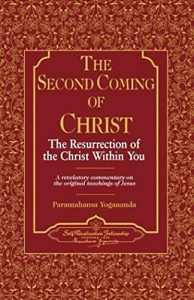
Buy The Second Coming of Christ: The Resurrection of the Christ Within You on Amazon As an affiliate, we may earn a small commission at no extra cost to you.