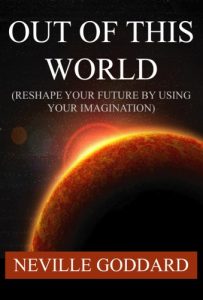
There’s an odd gap in most Neville Goddard reading lists. People recommend Feeling Is the Secret, The Power of Awareness, Awakened Imagination, sometimes Your Faith Is Your Fortune. But Out of This World? Almost never. It doesn’t show up in “Start Here” threads. It doesn’t get quoted on social media. It sits quietly on the shelf, passed over again and again.
I ignored it for two years. When I finally read it (mostly because I’d exhausted the rest of Neville’s catalog) I spent the first ten pages wondering why I’d waited so long, and the last ten pages wishing the book was three times longer.
Out of This World is Neville’s most unusual, most intellectually adventurous, and most underappreciated work. It’s also the one that, for me personally, made his entire system suddenly make sense on a level that the other books hadn’t reached.
What Makes This Book Different
In his other works, Neville presents his ideas primarily through biblical interpretation and psychological terminology. Out of This World takes a different approach: it frames imagination and consciousness in terms that overlap with physics and philosophy, specifically, the concept of higher-dimensional thinking.
Neville’s argument runs like this: ordinary thinking operates within the three-dimensional world of space and time. You observe what exists, react to it, and try to change it through physical effort. This is “thinking from” your current circumstances: letting the world define your consciousness.
But there’s another mode of thinking that Neville calls “thinking FROM the end”, placing your awareness in the fulfilled desire and perceiving the world from that vantage point. This, he argues, operates in a fourth dimension that isn’t bound by the same rules of cause and effect. In this dimension, the end state doesn’t need to be “caused” by a series of prior events. It exists already as a reality, and by placing your consciousness there, you draw the three-dimensional world into alignment with it.
“To think fourth-dimensionally is to think from the end. The world of the imagination is the world of the fourth dimension. It is our real home. It is the world that is the cause of the three-dimensional world which, in truth, is only its shadow.”
– Neville Goddard, Chapter 1
Why This Frame Changed Everything for Me
I’d been practicing Neville’s techniques for over a year when I read this book, and I’d been getting results: enough to convince me something real was happening, not enough to fully commit. The sticking point was always: how? How can imagining something cause it to appear in physical reality? The mechanism didn’t make sense within a three-dimensional, linear-causation worldview.
Out of This World gave me a conceptual framework that made the “how” comprehensible. Not as a supernatural miracle, but as a natural process operating in a dimension of reality that our ordinary thinking doesn’t access. Whether Neville’s fourth-dimensional model maps onto actual physics is debatable (more on that below). But as a mental model for understanding how imagination might affect reality, it’s the most useful framework I’ve encountered.
The specific insight that clicked was this: when Neville says “think FROM the end,” he means something very specific. Not “think ABOUT the end” (visualizing your desire from the outside, as a future event). But “think FROM the end” (placing your awareness inside the fulfilled state and perceiving everything else from that perspective). The preposition matters enormously. Thinking about the end keeps you in the present looking toward the future. Thinking from the end puts you in the future looking back at the present, and from that vantage point, the present rearranges itself.
That distinction (about versus from) was the missing piece in my practice. I’d been visualizing things I wanted (thinking about the end) and wondering why results were inconsistent. When I started actually occupying the state (thinking from the end), experiencing the world as someone who already had what I wanted, results became dramatically more reliable.
The Structure
Out of This World is very short, around 70 pages in most editions, divided into four chapters. Chapter 1 introduces the fourth-dimensional concept. Chapter 2 discusses the relationship between assumption and fact. Chapter 3 addresses power and the will. Chapter 4 deals with the relationship between desire and fulfillment.
The brevity is both a strength and a weakness. Neville writes with characteristic economy, no filler, no padding, every paragraph advancing the argument. But the ideas here are so unusual, so different from his other books’ framing, that they deserve more development. I wanted him to unpack the fourth-dimensional model further, provide more examples, address more objections. The book ends just when it’s getting started.
“What you earnestly desire already exists in the fourth dimension. To bring it into the third dimension (what you call physical reality) you must learn to think and feel from the state of its fulfillment, not toward it.”
– Neville Goddard, Chapter 2
The Physics Question
Neville invokes the concept of dimensions in a way that will make physicists uncomfortable. His “fourth dimension” isn’t the spacetime of Einsteinian physics, it’s a metaphysical dimension of consciousness or imagination that interpenetrates the physical world. He borrows the language of higher dimensions without strictly adhering to the mathematical framework behind it.
This is a fair criticism. Neville wasn’t a physicist, and his use of dimensional language is more metaphorical than technical. If you’re looking for a rigorous connection between consciousness studies and dimensional physics, you won’t find it here.
But as a thought experiment, as a way of conceiving how consciousness might relate to physical reality in a non-linear way, the model is surprisingly useful. And it’s worth noting that some interpretations of quantum mechanics (particularly the consciousness-related interpretations that Wheeler, von Neumann, and Wigner explored) do suggest that consciousness may play a more fundamental role in physical reality than classical physics allows. Neville was onto something, even if his formulation of it doesn’t meet scientific standards of rigor.
What This Adds to the Neville Canon
Every other Neville book tells you what to do (assume the feeling of the wish fulfilled) and grounds it in Scripture or psychology. Out of This World is the only place where Neville offers a structural model for how it works. Not in terms of subconscious programming or divine law, but in terms of the architecture of reality itself. If consciousness operates in a dimension where outcomes exist simultaneously rather than sequentially, then “feeling the wish fulfilled” isn’t creating something new, it’s selecting a pre-existing reality from a field of possibilities.
This frame resolves several problems that Neville’s other formulations leave open. Why does persistence matter? Because you’re stabilizing your position in a particular dimensional reality, and flickering between states produces flickering results. Why does the time delay exist? Because three-dimensional reality has inertia. It takes time for the shadow to conform to the new shape casting it. Why does doubt undermine results? Because doubt shifts your dimensional position back to the old reality.
These explanations may not be scientifically valid. But they’re internally consistent, practically useful, and give the practitioner a much clearer understanding of what they’re actually doing when they “live from the end.”
A Practice Inspired by This Book
The “thinking FROM” practice, which this book describes more clearly than any other Neville text:
Choose a specific desire. Now, instead of imagining it as a future event you’re moving toward, place yourself (right now, eyes closed, sitting comfortably) at the point after it has been fulfilled. You’re there. It’s done. You’re looking back at today from a point in the future where everything worked out.
From that vantage point, how does today look? What’s your emotional relationship to the problems you were worried about this morning? (They got resolved. You can see that from where you stand now.) What’s the texture of your inner life? (Calmer, more satisfied, quietly grateful.)
Stay in that perspective for five minutes. Don’t visualize the desire itself, visualize FROM the fulfilled state. See the world, feel the world, as it appears from the position of already having what you wanted. Notice how different this feels from ordinary visualization, which keeps you on the “wanting” side of the gap.
Do this daily for one week and pay attention to two things: how quickly your emotional state shifts during the practice, and whether circumstances begin conforming to the assumed state between sessions. In my experience, the emotional shift is almost immediate. The circumstantial shifts take longer but follow reliably if you persist.
The Verdict
Four stars, would be five if it were longer. Out of This World is the missing puzzle piece in Neville’s catalog, the book that provides a structural understanding of what all the other books ask you to do on faith. It’s intellectually adventurous, practically useful, and criminally underread.
If you’ve read Neville’s other works and found them inspiring but conceptually incomplete (if you’ve been wondering “but HOW does consciousness create reality?”) this tiny book offers the most satisfying answer in his entire body of work. It won’t convince a skeptic, and it won’t satisfy a physicist. But for a practitioner looking for a deeper understanding of the mechanics behind the method, there’s nothing else like it.
The book nobody talks about might be the one everybody needs to read.
Enjoyed this review?
Buy Out of This World on Amazon As an affiliate, we may earn a small commission at no extra cost to you.