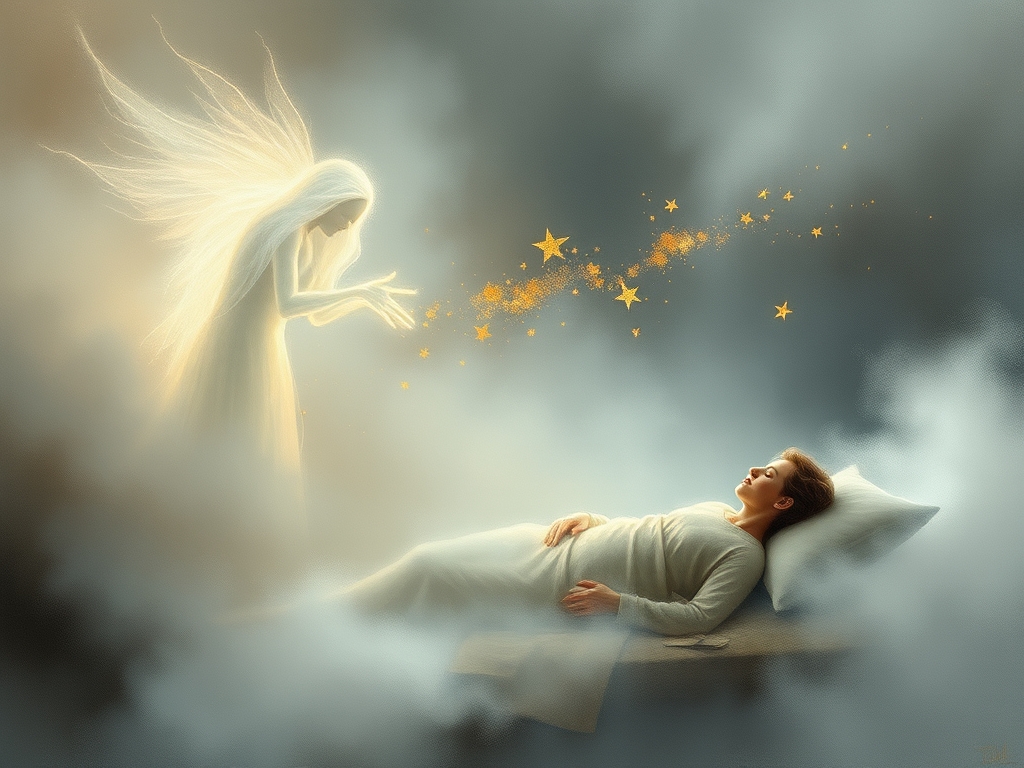
My grandmother died when I was twenty-three. Two weeks later, she appeared in a dream. She was sitting in her kitchen, the one I remembered from childhood, and she looked at me with that expression she always had when she knew something I didn’t. She said one sentence: “I’m fine. Don’t worry about me.”
I woke up with tears on my face and a peace in my chest that the grief hadn’t allowed in weeks.
Was it really her? Was it my subconscious giving me what I needed? Does the distinction even matter?
Two Frameworks, Both Valid
I want to present two ways of understanding dreams of the deceased, and I want to be honest that I hold both without fully resolving the tension between them.
The Psychological Framework
From a psychological perspective, dreams of deceased loved ones are a natural part of the grief process. Your subconscious mind is processing the loss, and the dream provides a space for the relationship to continue in an altered form. The dead person in the dream represents your internalized image of them: your memories, your feelings about them, your unresolved emotions.
This framework sees the dream as coming entirely from within you. The deceased person is a character in your internal drama, created by your subconscious to help you process grief, resolve guilt, or find closure.
Joseph Murphy worked within this framework:
“Your subconscious mind is the storehouse of memory. It stores all your experiences and all your impressions of the people you have known.”
Joseph Murphy
The Spiritual Framework
Many spiritual traditions hold that consciousness survives physical death and that the deceased can communicate through dreams. In Hinduism, the space of dreams (svapna) is considered a meeting ground between different levels of consciousness. Yogananda spoke explicitly about life after death and the continuation of the soul:
“Death is not the end; it is merely a transition from one state of existence to another.”
Paramahansa Yogananda
In this framework, a dream of a deceased loved one might be an actual visitation. Not a memory or a psychological projection, but a genuine contact between your consciousness and theirs.
How to Tell the Difference
Is it a grief-processing dream or a visitation? People who study this distinction (and there are researchers who take this seriously) have noted that visitation dreams tend to share certain characteristics:
- The deceased appears healthy, whole, and often younger than they were at death.
- The dream has a different quality than normal dreams: clearer, more vivid, more “real.”
- The message is simple, often reassuring. “I’m okay.” “I love you.” “Don’t worry.”
- The dreamer wakes up with a strong emotional impact, often peace rather than distress.
- The dream doesn’t fade as quickly as normal dreams. You remember it vividly for days, weeks, sometimes years.
Ordinary grief dreams, by contrast, tend to be more confused, more emotionally complicated, and more reflective of the dreamer’s unresolved feelings. The deceased might appear sick, confused, or upset. The dream feels more like a normal dream, with shifting scenes and illogical events.
My grandmother dream had every characteristic of a visitation dream. But I also acknowledge that my intense need for reassurance might have generated exactly the dream I needed. I’m comfortable not knowing for sure.
When the Dream Carries a Message
Whether the source is internal or external, dreams of the deceased often carry messages that deserve attention.
Messages of reassurance: “I’m fine.” “Don’t cry.” “I’m at peace.” If you receive this message, consider accepting it, whatever its source. Your grief doesn’t need to continue at the same intensity to honor the person you lost.
Messages of guidance: Sometimes the deceased offers specific advice or points toward something in your life that needs attention. These messages are worth sitting with, even if you ultimately interpret them as your own subconscious wisdom wearing a familiar face.
Unfinished business: If the deceased appears distressed or the dream involves conflict, this usually points to something unresolved between you. Guilt, anger, things left unsaid. The dream is offering a space to complete what life didn’t allow.
A Practice for After the Dream
- Write it down. Every detail, every word, every feeling. These dreams are precious and they fade.
- Sit with it. Don’t immediately interpret. Let the dream live in you for a day before you analyze it. Feel what it’s doing to your emotional landscape.
- Respond if needed. If there was unfinished business, write a letter to the deceased. Not to send, but to complete the conversation. Say what you need to say. Then, if it feels right, burn the letter or bury it. Let it go.
- If the dream was peaceful, receive it as a gift. Don’t question it to death. Let it bring you peace.
- If you want to invite another dream, before sleep, hold the person gently in your awareness. Not with grasping or desperate calling. With love. With openness. “If there’s more to say, I’m listening.”
What I Believe
I believe that consciousness is more vast than our waking minds can comprehend. I believe that the relationships we form in life don’t simply evaporate at death. And I believe that the state of dreaming, which the Mandukya Upanishad calls a world created entirely by consciousness, is a space where things can happen that our materialist worldview has no room for.
Whether my grandmother actually visited me or my subconscious created a perfect simulation of her visit, the effect was real. The peace was real. The love was real. And maybe, in the end, that’s the only thing that matters.
If someone you’ve lost comes to you in a dream, receive them with gratitude. Let them say what they came to say. And when you wake, carry the love with you. That part, at least, you can be sure is real.