The Morning I Stopped Choosing Between Teachers
For a long time I felt like I had to pick a lane. Neville people and Murphy people don’t always see eye to eye. And Yogananda’s tradition, with its emphasis on meditation and Kriya Yoga, can feel like a different world entirely from the conscious manifestation work of the New Thought teachers.
But when I actually looked at what each teacher was asking me to do in practical terms, I found they weren’t contradicting each other. They were each illuminating a different facet of the same diamond. And I realized I could build a single morning practice that honored all three without diluting any of them.
Here’s the routine I’ve been doing for about eighteen months now. It takes 35 to 45 minutes. On rushed mornings I trim it to 20. It’s the most grounded I’ve ever felt.
Phase One: Stillness (Yogananda’s Gift) – 10 Minutes
I start with meditation. Not visualization. Not affirmation. Just stillness.
Yogananda taught that the mind needs to be calm before it can be directed effectively. Trying to impress the subconscious with a scattered mind is like trying to write on water. The words dissolve before they land.
“Be as simple as you can be; you will be astonished to see how uncomplicated and happy your life can become.”Paramahansa Yogananda
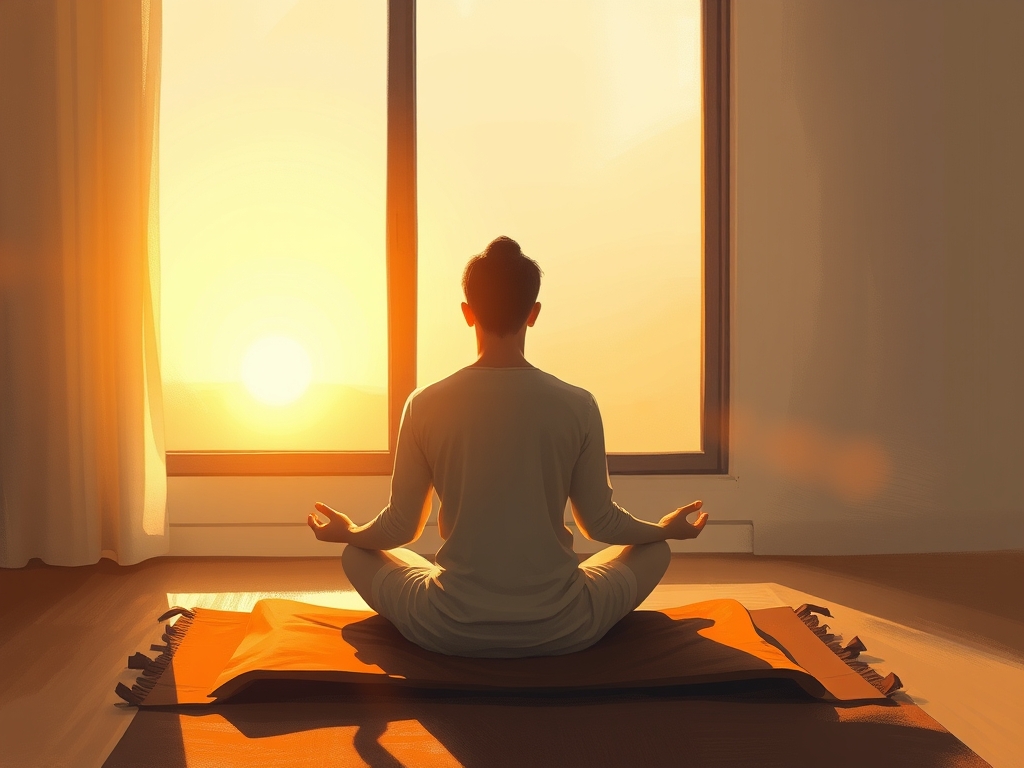
I sit upright, spine straight but not rigid, and focus on my breath. I don’t use a mantra at this stage. Just breath awareness. Inhale slowly through the nose, exhale slowly. If thoughts arise, I let them pass. I’m not trying to achieve a mystical state. I’m settling the water so I can see to the bottom.
After about five minutes of this, I shift my attention to the point between my eyebrows, what Yogananda called the spiritual eye. I hold my gaze there gently for another five minutes. This focus tends to deepen the stillness considerably. Some mornings it feels like sinking into warm water. Other mornings my mind chatters the whole time. Both are fine. I show up regardless.
Phase Two: Gratitude and Inner Conversation (Murphy’s Contribution) – 10 Minutes
From the stillness, I transition into what Murphy would recognize as subconscious programming through positive affirmation and gratitude.
With my eyes still closed, I begin with three statements of gratitude for things that are already true in my life. These are specific and felt. Not “I’m grateful for my health” in a generic way, but “I’m grateful that I woke up without pain this morning and that my body carried me through yesterday.” The specificity makes the feeling real.
Then I move into affirmations for the day. Murphy taught that the subconscious accepts what the conscious mind affirms with feeling and repetition:
“Busy your mind with the concepts of harmony, health, peace, and good will, and wonders will happen in your life.”Joseph Murphy
I use three affirmations that I’ve chosen for the current season of my life. I hold each one for about two minutes, repeating it slowly and feeling into it. Right now my three are related to a creative project, a health goal, and a relationship I’m deepening. Every few months I update them.
The key here is that the preceding meditation has quieted my conscious mind. The affirmations land differently after stillness than they would if I just woke up and started chanting them at the bathroom mirror. Murphy and Yogananda complement each other perfectly in this sequence.
Phase Three: Living in the End (Neville’s Technique) – 10 Minutes
Now comes the imagination work. With my mind still and my emotional state elevated by gratitude, I step into a scene that implies the fulfillment of my primary desire.
This is pure Neville. I construct a brief scene, always from first person, always implying that my desire has already been fulfilled. I see it, hear it, touch it, feel it. I loop the scene until it takes on a quality of reality, until it feels less like something I’m constructing and more like something I’m experiencing.
“Assume the feeling of the wish fulfilled and observe the route that your attention follows.”Neville Goddard
Some mornings the scene comes alive quickly. Other mornings it stays flat. I’ve learned not to judge sessions by how vivid they feel. The cumulative effect matters more than any single day’s experience.
After the scene work, I sit quietly for a minute or two and let any impressions settle. Sometimes an insight arises. Sometimes there’s just peace. Then I open my eyes, take a few breaths, and move into my day.
Phase Four: The Bridge to Action (5 Minutes)
This last phase is my own addition, born from the practical realization that inner work needs to connect to outer movement. Before I leave my practice space, I write down one concrete action I’ll take today that aligns with my desire. Not a massive action. Something doable. An email I’ll send. A page I’ll write. A conversation I’ll initiate.
Yogananda was clear that meditation and right action go together. Neville emphasized that inspired action flows naturally from the assumption of the wish fulfilled. Murphy taught that the subconscious works through you, moving you toward opportunities. All three teachers agree: you’re not a passive recipient. You’re a participant.
The Trimmed Version for Busy Mornings
Some mornings you have 20 minutes, not 45. Here’s what I do on those days:
- 5 minutes of breath meditation (Phase One, abbreviated)
- 3 minutes of gratitude with one affirmation (Phase Two, compressed)
- 7 minutes of scene work (Phase Three, slightly shortened)
- Quick mental note of one action for the day (Phase Four, no writing)
The order stays the same. Stillness first, then programming, then imagination, then action. That sequence matters because each phase prepares you for the next.
Exercise: Build Your Own Version This Week
Take the four-phase structure and customize it. Choose your own affirmations. Design your own scene. Pick a meditation approach that suits you, whether it’s breath awareness, a mantra, or simply sitting in silence.
Try the routine for five consecutive mornings. On the fifth day, evaluate: What’s working? What feels forced? What could you adjust?
The goal isn’t to follow my routine exactly. It’s to build your own practice that draws on the strengths of each teacher. Yogananda gives you the calm mind. Murphy gives you the programming method. Neville gives you the creative imagination. Together, they’re remarkably complete.
And here’s what I’ve found after eighteen months: the practice stops feeling like three separate techniques and starts feeling like one unified conversation with your deeper self. The boundaries between the teachers dissolve. What remains is simply you, sitting in the morning light, tending to the garden of your own consciousness.