I spent years arguing with God before I realized I was arguing with my own idea of God.
The God I’d been given as a concept, an old man on a throne, keeping score, didn’t survive contact with real life. So I did what a lot of people do. I threw the whole thing out. If that God didn’t make sense, then maybe there was no God at all.
It took Paramahansa Yogananda to show me a third option I hadn’t considered: that the problem wasn’t God. The problem was that I was trying to stuff the Infinite into a box built for something finite.
Yogananda had one of the most expansive, and yet somehow intimate, understandings of God I’ve ever encountered. He didn’t choose between the personal God of devotion and the impersonal Absolute of philosophy. He held both in his hands and said: these are not two different things. They’re two faces of the same Reality.
The Debate That Divides Seekers
This question, is God personal or impersonal?, has split spiritual seekers for millennia.
On one side, you have the devotional traditions. Christianity, Bhakti Hinduism, Sufism. God is a Being. God loves. God listens. God responds to prayer. You can have a relationship with God, the way a child has a relationship with a parent. This is God as Father, as Mother, as the Beloved.
On the other side, you have the philosophical and mystical traditions. Advaita Vedanta, certain strands of Buddhism, the more abstract reaches of Neoplatonism. God is not a being, God is Being itself. Pure Consciousness. The Absolute. Brahman without qualities. You can’t have a relationship with it any more than a wave can have a relationship with the ocean it’s made of.
Most teachers land firmly on one side. Yogananda refused to.
The Divine Mother
One of the most beautiful aspects of Yogananda’s spirituality was his deep, personal devotion to God as the Divine Mother. This wasn’t abstract theology for him. It was the most intimate relationship of his life.
He prayed to the Divine Mother. He wept for Her. He spoke to Her with the raw tenderness of a child calling out in the dark. In his writings and talks, collected in Man’s Eternal Quest, he described this relationship with startling vulnerability:
“God is the nearest of the near, the dearest of the dear. Love God as a miser loves money, as an ardent man loves his sweetheart, as a drowning person loves breath. When you yearn for God with intensity, He will come to you.”
– Paramahansa Yogananda
This isn’t the language of abstract philosophy. This is love poetry. And Yogananda meant every word of it. He experienced God as a responsive Presence, someone who answered, who comforted, who guided.
He often addressed God as “Mother” because, he said, a mother’s love is the closest human approximation of divine love. A father’s love can be conditional. A mother’s love, at its purest, simply is. It doesn’t withdraw because you’ve failed. It doesn’t diminish because you’ve wandered.
I’ll admit, this was hard for me at first. I come from a tradition where God is firmly “He,” and the idea of a Divine Mother felt foreign. But something in Yogananda’s devotion cracked me open. There’s a quality of tenderness in approaching God as Mother that I hadn’t found anywhere else. A permission to be small. To need. To not have it all figured out.
And Yet, the Infinite
Here’s where Yogananda keeps you off balance. Because he could shift in a single paragraph from this achingly personal devotion to the most vast, abstract descriptions of Ultimate Reality.
In Autobiography of a Yogi, he describes his first experience of cosmic consciousness, an experience his guru Sri Yukteswar triggered by striking him gently on the chest:
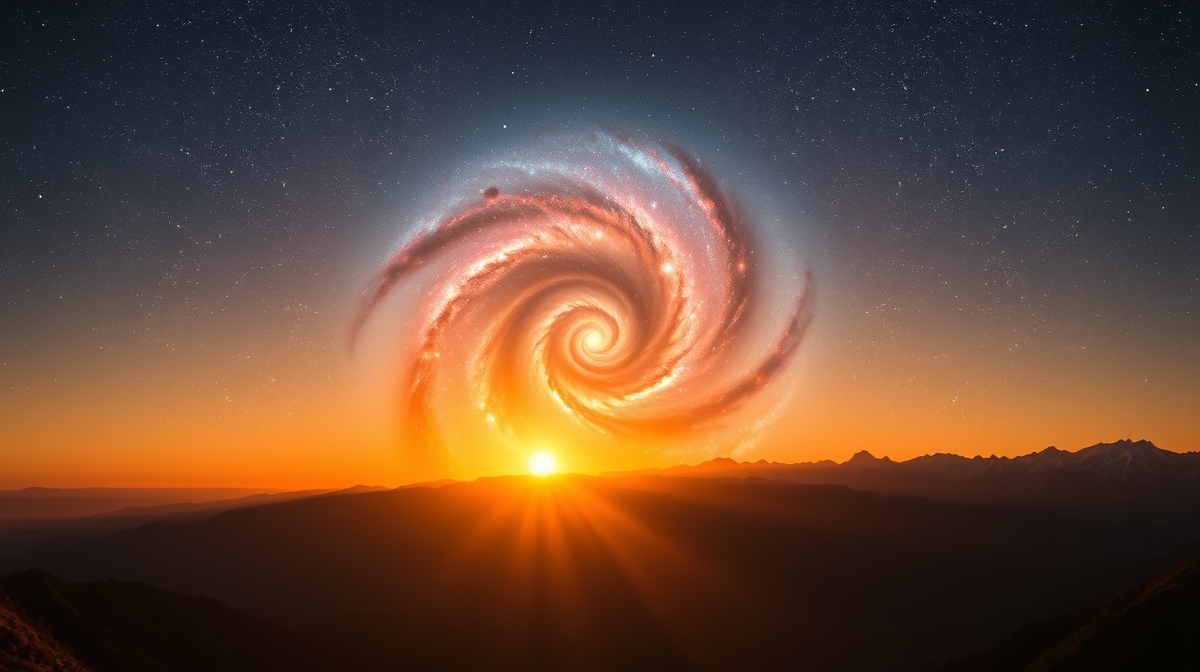
“My sense of identity was no longer narrowly confined to a body, but embraced the circumambient atoms… The entire vicinity lay bare before me. My ordinary frontal vision was now changed to a vast spherical sight, simultaneously all-perceptive… A swelling glory within me began to envelop towns, continents, the earth, solar and stellar systems, tenuous nebulae, and floating universes.”
– Paramahansa Yogananda, Chapter 14
This is not a personal God sitting somewhere listening to prayers. This is Consciousness itself, infinite, all-pervasive, beyond form. And Yogananda experienced this not as a contradiction to his devotion, but as its fulfillment.
That’s the key insight. For Yogananda, the personal and impersonal aren’t opposites. They’re dimensions. God as the Divine Mother is how the Infinite makes itself knowable to the human heart. God as Cosmic Consciousness is what the Divine Mother actually is, beyond the veil of form.
Bridging East and West
What made Yogananda unusual, almost unique, was his ability to hold Hindu and Christian understandings of God together without forcing either one to submit.
He spoke of Christ with the same reverence as Krishna. He saw the Christian Trinity (Father, Son, Holy Spirit) as perfectly parallel to the Vedantic understanding of Sat-Tat-Aum (God beyond creation, God in creation, and the creative vibration itself). He didn’t do this by watering down either tradition. He did it by going deep enough into both to find where they converge.
When Yogananda spoke of “Christ Consciousness,” he didn’t mean something that belonged exclusively to Jesus. He meant the infinite intelligence present in every atom of creation, what the Hindu tradition calls Kutastha Chaitanya. Jesus embodied it fully. So did Krishna. So did other great masters. And so, Yogananda insisted, can you.
This was radical in the 1920s and ’30s. It’s still radical now. Most interfaith dialogue today operates on the surface, we all worship the same God, let’s be nice to each other. Yogananda went far deeper. He mapped the actual metaphysical structures of different traditions onto each other and showed that they’re describing the same reality from different angles.
What This Means for Practice
So what does all of this mean when you sit down to meditate or pray?
It means you don’t have to choose.
If your heart naturally reaches toward a personal God, if you want to pray, to ask, to pour out your love toward a Presence that feels real, Yogananda would say: do it. That impulse is not naive. It’s not primitive. It’s one of the most direct paths to the Divine there is.
And if your mind naturally inclines toward the impersonal, if the idea of a “God” with preferences and personality feels too small, Yogananda would say: follow that instinct too. Meditate on the Infinite. Seek the consciousness behind consciousness. That’s equally valid.
But don’t let either approach calcify into a position. The devotee who refuses to see beyond the personal God will eventually hit a wall. The philosopher who refuses to bow will eventually hit a different wall. The fullest experience, Yogananda taught, includes both, the warmth of devotion and the vastness of pure awareness, spiraling around each other like a double helix.
A Practice for This Week
Here’s something simple you can try, drawn from Yogananda’s approach.
Sit quietly for ten minutes. For the first five minutes, speak to God personally, as Mother, Father, Friend, Beloved, whatever feels most natural. Don’t recite formal prayers. Just talk. Tell the truth about your day, your fears, your gratitude. Be as honest as you would be with someone who already knows everything about you and loves you completely.
Then, for the next five minutes, stop talking. Stop imagining a person or a form. Simply sit in the awareness that something vast and conscious is present. Not separate from you, but as the very awareness through which you’re experiencing this moment. Don’t try to grasp it. Just rest in it.
Notice what happens. Notice if one mode comes more naturally. Notice if, at some point, the two modes begin to blur, if the personal warmth and the impersonal vastness start to feel like the same thing experienced differently.
That blurring, I think, is what Yogananda lived in. Not the personal God. Not the impersonal Absolute. But the living, breathing, endlessly creative Reality that is somehow, impossibly, both.
I don’t claim to live there myself. Most days I’m fumbling between the two, reaching for warmth when I feel lost and reaching for spaciousness when I feel trapped. But every now and then, for a few seconds in deep meditation, the distinction dissolves. And in those seconds, I understand. Not intellectually, but in my bones, what Yogananda was pointing at all along.
God is not a concept to be resolved. God is an experience to be had. And that experience, when it finally comes, laughs at all our categories.