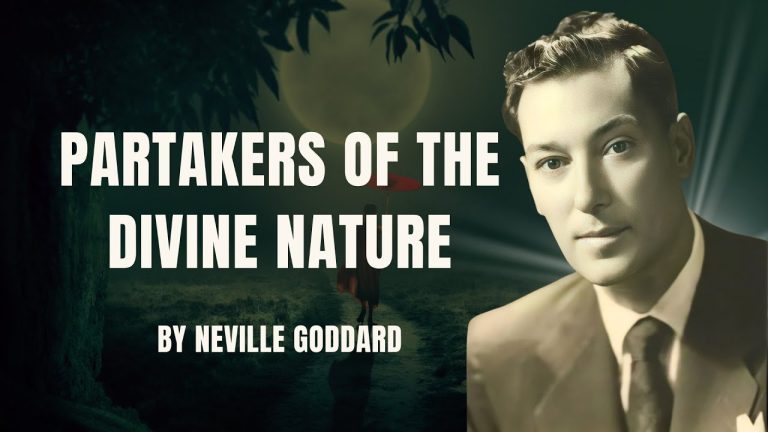
A Book of the Mind, Not of History
The first time I heard Neville Goddard say that the Bible is not a record of historical events, I thought he was being provocative. Then I kept reading. And I realized he wasn’t being provocative at all, he was completely serious, and he’d built an entire system of thought on this single premise.
For Neville, every character in the Bible is a state of consciousness. Every story is a psychological drama. Every miracle is a description of what happens when imagination operates on belief. He didn’t pick and choose which parts to read allegorically, he read the entire thing, cover to cover, as a manual for the human mind.
This approach either electrifies you or bewilders you. For me, it did both.
Abraham, Isaac, and Jacob, The Architecture of Creation
Neville’s reading of the patriarchs is where his psychological interpretation becomes most illuminating. He laid this out extensively in Your Faith Is Your Fortune, published in 1941, and returned to it throughout his career.
Abraham, in Neville’s framework, represents your awareness, the pure “I AM,” the fact that you exist and are conscious. Abraham is the father because awareness is the origin of everything you experience. Before there is a desire, before there is a belief, there is the simple fact of being aware.
Isaac represents your desire, the specific thing you want to experience or express. Isaac is the “promised son” because every genuine desire is, in Neville’s view, a promise from your deeper self that the thing is possible. Isaac is what awareness conceives.
Jacob, and this is where it gets interesting, represents your imagination. Jacob is the one who acts, who schemes, who takes the formless desire and gives it shape. Jacob steals Esau’s birthright by covering his smooth hands with goat skin to feel like his hairy brother. Neville saw this as a perfect allegory: imagination succeeds by making the unreal feel real. You assume a state that isn’t yet yours, you clothe yourself in its sensory reality, and the subconscious (Isaac, who is blind) accepts the imagined state as fact.
“The characters of the Bible are not persons who once lived in the flesh. They are states of consciousness personified. Abraham, Isaac, Jacob, Father, Son, and Grandson, are the eternal Awareness, the Desire, and the Imagination of the individual.”
– Neville Goddard (1941)
Once you see this pattern, it’s hard to unsee it. The entire Genesis narrative becomes a blueprint for how consciousness creates experience: awareness generates desire, desire is shaped by imagination, and imagination, by assuming the feeling of the fulfilled state, brings it into manifestation.
Moses at the Burning Bush
One of Neville’s most repeated interpretations was the story of Moses and the burning bush. God speaks from the bush and declares His name: “I AM THAT I AM.” For most traditions, this is a statement about God’s eternal, transcendent nature.
For Neville, it was something far more intimate. He read “I AM” as the fundamental name of your own consciousness. When you say “I am,” you’re not just describing yourself, you’re invoking the creative power. Whatever you attach to “I am” becomes your reality. “I am poor.” “I am unloved.” “I am healthy.” “I am successful.” Each completion of the phrase is an act of creation.
The bush burns but is not consumed, consciousness is always on fire with creation but is never depleted. It’s always generating experience based on whatever “I am” statement is most deeply felt.
This interpretation turns prayer inside out. You’re not petitioning an external God. You’re directing the only God Neville acknowledged, your own awareness, by choosing what follows “I am.”
Water Into Wine, Your First Miracle
The wedding at Cana, where Jesus turns water into wine, is typically read as a demonstration of divine power. Neville read it as a lesson in mental transformation.
Water, in his system, represents your current psychological state, flat, ordinary, unfulfilling. Wine represents the desired state, rich, intoxicating, alive. The “miracle” is the act of changing your inner state from one to the other through imagination. You don’t wait for external circumstances to change. You transform the water of your present consciousness into the wine of your wished-for experience, internally, first, and the external world follows.
The detail Neville loved was that Jesus told the servants to fill the water jars to the brim. Don’t hold back. Don’t imagine halfway. Fill your consciousness completely with the new assumption. Half-hearted imagining produces nothing.
Lazarus, Reviving a Dead State
The raising of Lazarus was, for Neville, about resurrecting any state of consciousness you’ve given up on. Lazarus has been dead four days, the situation seems permanent, hopeless, beyond recovery. Martha says, “Lord, by this time he stinketh.” It’s over.
But imagination doesn’t accept “it’s over.” You can revive a dead dream, a collapsed relationship, a failed ambition. Not by working on the external situation, but by re-entering the state of consciousness in which that thing is alive and real. You imaginatively roll away the stone (the barrier of belief that says it’s impossible), and you call Lazarus forth.
Neville pointed out that Jesus wept at the tomb. Not because he doubted, but because the world’s acceptance of death as final moved him. The entire story, in Neville’s reading, is a confrontation between the world’s insistence that some things can’t change and imagination’s quiet certainty that nothing is final.
The Practical Side of Allegorical Reading
There’s a common objection to Neville’s approach: isn’t this just cherry-picking? Can’t you make any ancient text mean anything if you try hard enough?
Maybe. But here’s what I’ve noticed after spending time with his interpretations: they’re internally consistent. He doesn’t just grab random stories and assign random meanings. There’s a coherent psychological system underneath, consciousness as the only reality, imagination as the creative agent, feeling as the language the subconscious understands, states of consciousness as the “places” you move between.
Every interpretation reinforces this system. And the system works. Not just as philosophy, but as something you can test in your own life.
Neville himself put it this way:
“The Bible is a revelation of the laws and functions of Mind expressed in the language of that age… It is the greatest psychological treatise ever written. But you will miss its purpose if you read it as history.”
– Neville Goddard (1941)
An Exercise: Read a Familiar Story With New Eyes
Pick any Bible story you know well, David and Goliath, Daniel in the lions’ den, the Exodus from Egypt. Before you re-read it, set this intention: “Every character in this story is a part of my own mind. Every event is something that happens in consciousness.”
Then read it slowly. Ask yourself:
- Who or what does each character represent in terms of my awareness, my desires, my fears, my beliefs?
- What is the conflict, psychologically? What inner state is opposing what other inner state?
- What is the resolution? What does it look like when this is resolved inside me?
You don’t need to arrive at the “right” answer. Neville’s interpretations are one lens, not the only lens. The value is in the shift of reading posture, from passive historical reception to active psychological engagement.
When I first tried this with the Exodus story, reading Egypt as a state of mental bondage and the Promised Land as the state of consciousness I wanted to inhabit, something clicked that years of Sunday school never touched. The story wasn’t about people who lived thousands of years ago. It was about a passage I could make tonight, in my own mind, by refusing to identify with the state of limitation and imaginatively crossing into the state of freedom.
Not Disrespect, A Deeper Respect
I want to be clear about something: Neville wasn’t dismissing the Bible. He was, in his own way, elevating it. He was saying this book isn’t merely a record of things that happened to other people in a distant past. It’s a living document about what’s happening inside you right now. Every story is your story. Every character is you.
That’s either the most arrogant thing you’ve ever heard, or the most liberating. For Neville, it was simply the truth, and the only way the Bible made any sense at all.
Whether you agree with every one of his specific interpretations is beside the point. The invitation is to approach scripture, or any sacred text. Not as a spectator, but as a participant. To read it as if it were written about your consciousness, for your consciousness, by your consciousness.
You might be surprised what starts speaking back.