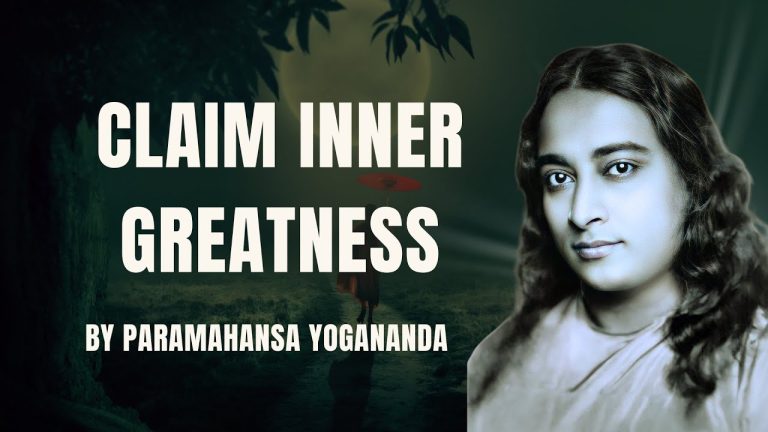
In the autumn of 1920, a twenty-seven-year-old Bengali monk stepped off a ship in Boston Harbor. He carried almost nothing, a few belongings, limited English, and a conviction that wouldn’t bend. He’d been sent by his guru, Sri Yukteswar, and by what he understood to be a direct spiritual commission, to bring the ancient science of Kriya Yoga to the West. He knew almost no one in America. He had no organization, no wealthy sponsors, no roadmap. What he had was a calling so absolute that it functioned as a kind of gravity, everything else would have to arrange itself around it.
That monk was Paramahansa Yogananda, and the story of his arrival in America is one of the most quietly remarkable chapters in modern spiritual history.
The Congress That Opened the Door
Yogananda didn’t come on a whim. He’d been invited to serve as India’s delegate to the International Congress of Religious Liberals, held in Boston in October 1920. The Congress was a gathering of progressive religious thinkers from around the world, Unitarians, liberal theologians, interfaith advocates. It was a niche event by any measure. But for Yogananda, it was a door he’d been waiting for.
He described the invitation arriving at a spiritually charged moment. He was running a school for boys in Ranchi, India, when the letter came. His response wasn’t careful deliberation, it was immediate recognition. This was the opening his guru had spoken of.
“The speech at the Congress of Religions in Boston was well received. A little body of students soon gathered around me.”
– Paramahansa Yogananda, Chapter 37
That understated line conceals an enormous amount of struggle. “Well received” doesn’t capture what it meant for a young Indian swami in saffron robes to stand before an American audience in 1920 and speak about the unity of all religions, the science of God-communion, and yogic practices that most Americans had never encountered.
America in 1920
It’s worth pausing to think about what America looked like when Yogananda arrived. The Immigration Act of 1917 had already created the “Asiatic Barred Zone,” severely restricting immigration from most of Asia. The broader culture ran on a mix of post-war anxiety, nativist sentiment, and deep suspicion of anything that didn’t fit a narrow Protestant framework. Hinduism wasn’t mysterious and exotic to most Americans, it was simply foreign, and foreign meant suspect.
Yogananda was not the first Indian spiritual teacher to visit the United States. Swami Vivekananda had famously electrified the World Parliament of Religions in Chicago in 1893. But Vivekananda had come for a brief, spectacular visit. Yogananda came to stay. That was a different proposition entirely.
He faced the kind of prejudice that’s uncomfortable to read about. Restaurants that wouldn’t serve him. Hotels that turned him away. Audiences who came curious but wary. In some cities, organized opposition from religious groups who saw his teachings as a threat to Christian faith. He wrote about these difficulties with a gentleness that makes them easy to glide past, but they were real and constant.
Boston, Then the Road
After the Congress, Yogananda didn’t go home. He stayed in Boston and began lecturing. Slowly, then with growing momentum, people came. He spoke at halls, churches, private homes, wherever he could find a platform. His English improved rapidly. His warmth, his humor, his evident sincerity broke through barriers that his ideas alone might not have crossed.
For three years he remained based in Boston, building a following lecture by lecture, student by student. He founded the Self-Realization Fellowship in 1920, though it would be years before the organization took on the institutional form it has today. In those early days, it was essentially Yogananda and whoever showed up.
Then, in 1924, he began a transcontinental speaking tour that would take him across the United States. The scale of it is staggering. City after city, Philadelphia, Washington, Pittsburgh, Minneapolis, Denver, Salt Lake City, Seattle, Portland, San Francisco, Los Angeles. In many of these cities, he filled auditoriums. In Los Angeles, he spoke to an overflow crowd of three thousand at the Philharmonic Auditorium, with another five thousand reportedly turned away.
“Thousands of Americans received Kriya Yoga through my body. My body became just an instrument.”
– Paramahansa Yogananda, Chapter 37
That sense of being an instrument rather than a personality runs throughout his account of the American years. He never claimed the success as his own. He understood himself as a vessel for something that had been set in motion long before he was born.
The Prejudice He Refused to Carry
What strikes me most about Yogananda’s early years in America isn’t the crowds or the growth of SRF. It’s his response to the hostility he encountered. He didn’t harden. He didn’t grow bitter. He didn’t build walls between himself and the culture that sometimes rejected him.
There’s a passage where he describes being refused service at a restaurant. He writes about it with such equanimity that you could miss the pain underneath. But I don’t think we should miss it. A man far from home, dedicating his life to sharing something he believed could help people, being told he couldn’t sit at a table, that costs something, no matter how realized you are.
And yet his letters and lectures from this period show no trace of resentment. He loved America. Not in a naive way, he saw the contradictions, the materialism, the spiritual hunger hiding behind acquisition. But he saw something else too: openness. A willingness to try new things that he believed was unique among Western nations. He called America a spiritual “melting pot” decades before that phrase became complicated.
The Los Angeles Years
By 1925, Yogananda had settled in Los Angeles, which would become the permanent headquarters of Self-Realization Fellowship. The choice wasn’t accidental. He found in Southern California a receptivity to spiritual ideas that the East Coast, for all its intellectual sophistication, couldn’t quite match. The climate didn’t hurt either, he often remarked that it reminded him of India.
He established the SRF center on Mount Washington in Los Angeles in 1925, a property that remains the organization’s international headquarters to this day. From there, he continued lecturing, writing, and initiating students into Kriya Yoga. He also began work on the book that would become his most enduring legacy, Autobiography of a Yogi, published in 1946.
The Mount Washington years were productive but not easy. Funding was perpetually tight. Internal organizational challenges arose as SRF grew. And the broader culture still didn’t quite know what to make of an Indian swami living permanently in America, teaching meditation to housewives and businessmen and college students.
What His Perseverance Teaches
I think about Yogananda’s early American years whenever my own practice feels difficult, which, compared to founding a spiritual organization in a foreign country while facing systemic prejudice, is embarrassingly comfortable. The teaching I draw from his story isn’t really about willpower or grit, though he had plenty of both. It’s about alignment.
Yogananda didn’t push through obstacles by force of personality. He moved through them because he was so thoroughly aligned with his purpose that the obstacles, while painful, couldn’t actually stop him. There’s a difference between muscling through resistance and being so clear about your direction that resistance becomes almost beside the point.
Here’s a practice drawn from that principle, one I return to when I feel stuck or discouraged.
An Alignment Practice
Sit quietly and bring to mind whatever work or purpose feels most genuinely yours. Not what you think you should be doing, but what pulls at you from the inside. Hold it gently. Then ask yourself: If I knew with absolute certainty that this was mine to do, what would I do next? Don’t answer from the head. Wait. Let the answer rise from somewhere quieter. Often what emerges isn’t dramatic, it’s the next small, obvious step you’ve been avoiding. Take that step within twenty-four hours. Don’t wait for certainty. Yogananda didn’t have certainty. He had conviction, which is different, conviction moves, certainty sits still.
The Ripple That’s Still Moving
Yogananda lived in America for over thirty years, until his death in 1952. In that time, he initiated over 100,000 students into Kriya Yoga. He wrote a book that has sold millions of copies and been translated into more than fifty languages. Steve Jobs famously arranged for every attendee at his memorial service to receive a copy. George Harrison kept it on his nightstand. It was the only book on Yogananda’s own shelf when he arrived at the SRF hermitage, a single well-worn copy that he’d carried from India.
All of it traces back to a young monk stepping off a ship in Boston in 1920, carrying almost nothing, knowing almost no one, and refusing, quietly, warmly, stubbornly, to turn back.
Some missions don’t announce themselves with thunder. They begin with a man in unfamiliar clothes, standing in an unfamiliar city, trusting that what he’s been sent to do will find its way.