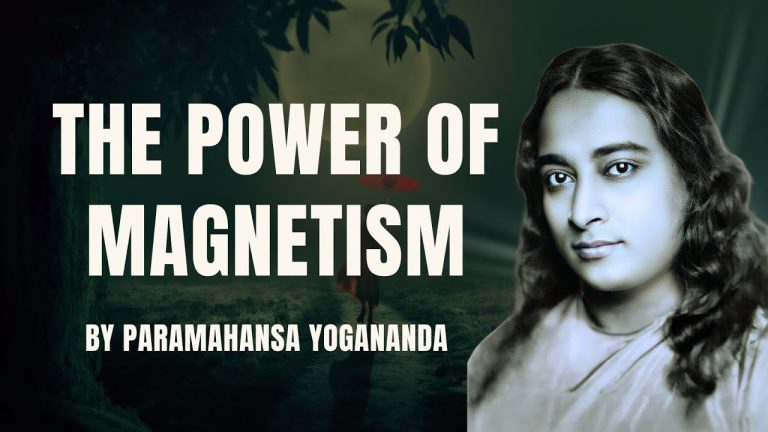
For years, I carried a quiet shame about wanting financial security. I’d been reading spiritual books since my early twenties, and somewhere along the way I absorbed the idea that wanting money was unspiritual. That truly enlightened people didn’t care about bank accounts. That poverty was somehow closer to God than prosperity.
Then I read Yogananda’s thoughts on money, and I felt something I hadn’t expected: relief.
Because Yogananda, a monk who renounced personal wealth, who lived simply and gave away nearly everything, didn’t condemn money. He didn’t worship it either. What he offered was something far more useful than either extreme: a balanced perspective that honored both the spiritual and the practical dimensions of human life.
The False Split Between Spirit and Money
There’s a persistent idea in spiritual circles that money and God occupy opposite ends of a spectrum. That the more spiritual you become, the less you should need material things. That desiring prosperity is a sign of attachment, of ego, of spiritual immaturity.
Yogananda rejected this completely.
“Making money honestly is a metaphysics in action. Making money is a duty of the householder. There is nothing wrong in making lots of money, provided you are not making it dishonestly and you are using it for good purposes.” – Paramahansa Yogananda (1944)
When I first encountered this passage, I read it three times. Here was a man who had willingly given up personal wealth, telling me that making money honestly was “a metaphysics in action.” He wasn’t tolerating money. He was calling the honest pursuit of it a spiritual act.
This distinction matters. Yogananda didn’t say “chase money.” He said “make money honestly, and use it for good purposes.” The emphasis was on the how and the why, not the how much.
What Actually Makes Money “Unspiritual”
If money itself isn’t the problem, what is? Yogananda was precise about this. The problem isn’t having money. It’s being had by money. It’s when the pursuit of wealth takes over your consciousness to the point where it becomes your primary identity, your main source of security, the thing you think about first and last every day.
I’ve been on both sides of this. There was a time when I was so worried about money that I couldn’t meditate without my mind drifting to bills. And there was a later time when I was earning well and became so focused on maintaining that income that I neglected every other dimension of my life. Both states were forms of bondage. Not because of the money, but because of my relationship to it.
Yogananda’s teaching helped me find the middle ground. Money is a tool. Like any tool, it can be used wisely or poorly. A hammer can build a house or break a window. The hammer doesn’t care. Neither does money.
Yogananda’s Practical Principles for Prosperity
What surprised me about Yogananda’s approach to money is how practical it was. He didn’t just speak in spiritual generalities. He gave specific principles that I’ve found genuinely useful.
Earn with Integrity
Yogananda insisted that the method of earning mattered as much as the amount. Money earned through deception, exploitation, or harm carries a psychological and spiritual weight that no amount of charity can offset. I’ve found this to be true in a very concrete way: the periods in my life when my income felt “clean”, earned through honest work that I believed in, were the periods when I felt most abundant, regardless of the actual numbers.
Don’t Hoard, Don’t Waste
He taught that money should circulate. Not recklessly, Yogananda wasn’t opposed to saving, but with an awareness that hoarding money out of fear creates a kind of energetic constipation. Money, like water, stays fresh when it moves. I’ve noticed that when I hold onto money tightly, from a place of scarcity, more scarcity seems to follow. But when I spend wisely, save reasonably, and give generously, there’s a flow that replenishes itself.
Use Wealth to Serve
For Yogananda, the highest use of money was service. Not just charity in the traditional sense, but any use of resources that genuinely helps others. Paying someone fairly. Creating employment. Supporting causes you believe in. Even spending money on your own education and health, so you can be more effective in the world.
“Seek spiritual riches within. If you want to find true happiness, earn money, but use it to serve others. That is the way to be happy.” – Paramahansa Yogananda (1988)
The Inner Work of Prosperity
Yogananda also taught that outer prosperity begins with inner states. This is where his teaching connects with the broader metaphysical tradition, the idea that your dominant mental state shapes your material circumstances.
If you’re constantly thinking “I don’t have enough” and feeling anxious about scarcity, that inner state becomes a kind of gravitational field that pulls more scarcity toward you. Not as punishment, but as reflection. Your outer world mirrors your inner world.
I’ve tested this in my own life, and while I can’t prove causation, the correlation has been striking. During periods when I’ve felt genuinely abundant. Not through denial of reality, but through a deep sense of trust that my needs would be met, opportunities have appeared with a regularity that’s hard to attribute to coincidence alone.
Conversely, during periods of intense financial anxiety, even when I was technically earning the same amount, everything seemed harder. Deals fell through. Unexpected expenses appeared. The money seemed to evaporate.
A Practice for Shifting Your Relationship with Money
Here’s a practice inspired by Yogananda’s teachings that I’ve used to slowly reshape my inner relationship with money. It’s not a get-rich technique. It’s a consciousness shift.
Each morning, before you check your bank account or think about bills, sit quietly for five minutes and do the following:
First, bring to mind three things in your life that money cannot buy that you already have. Health, a relationship, a talent, a moment of beauty you witnessed recently, anything that’s genuinely valuable and completely free. Let yourself actually feel the richness of having these things.
Second, say quietly to yourself: “I am open to receiving abundance in all its forms today. I use whatever comes to me wisely and generously.” Say it once, with feeling, and then let it go.
Third, think of one specific way you can be generous today, with your time, your attention, your money, or your skill. It doesn’t need to be large. Just one concrete act of generosity you’ll perform before the day is over.
This practice does two things. It reminds you that you’re already wealthy in ways that matter. And it sets an intention of openness and generosity that, over time, reshapes the subconscious patterns around money.
I’ve been doing this for about two years now, and the shift has been gradual but unmistakable. I worry less about money. I earn more. And more importantly, I enjoy money more. Not in a materialistic way, but in a way that feels aligned with something Yogananda would approve of. Money flows in, money flows out, and in between, it does some good.
Beyond the False Choice
The greatest gift Yogananda gave me regarding money was the dissolution of a false choice. I’d been living as if I had to choose between spiritual depth and material comfort. As if caring about my finances meant I was somehow betraying my meditation practice. As if wanting a nice home for my family was a sign of spiritual weakness.
Yogananda demolished that false choice with a kindness that felt personal, even though he wrote those words decades before I was born. Money is not your enemy. Poverty is not your friend. What matters is the state of your consciousness, how you earn, how you spend, how you relate to what you have and what you lack.
I still meditate every morning. I still pursue inner peace. And I also pay attention to my finances, build savings, invest in my work, and take care of the material needs of the people I love. These two dimensions of life aren’t in conflict. They never were. It was only my confused belief that made them seem so.
If you’ve been carrying that same confusion, the quiet guilt of wanting financial security while also wanting spiritual growth, I hope Yogananda’s words land in you the way they landed in me. With relief. With permission. And with the clear understanding that a full human life includes both the invisible riches of the spirit and the very visible, very practical reality of money well earned and well spent.