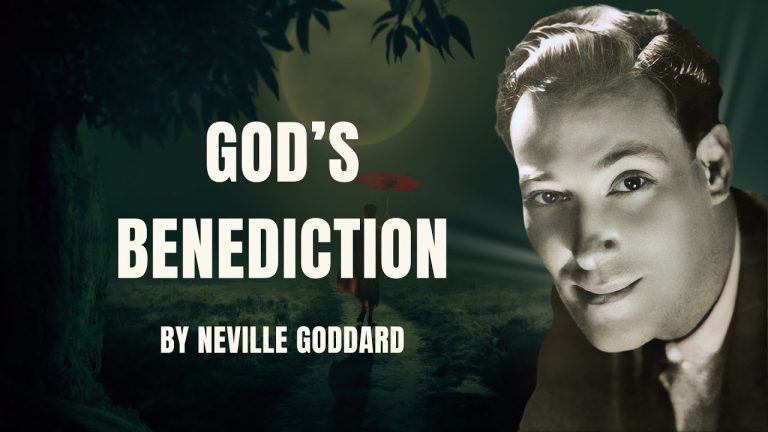
The Man Who Read the Bible Differently
I grew up going to church every Sunday. Pressed shirts, hymn books, wooden pews that creaked under the afternoon heat. By the time I discovered Neville Goddard in my late twenties, I’d already developed a complicated relationship with organized religion, drawn to the stories, repelled by the dogma. So when I heard Neville say that the entire Bible was a psychological drama taking place inside human consciousness, something in me exhaled for the first time in years.
But Neville’s relationship with religion wasn’t simple rejection. It wasn’t atheism dressed in metaphysical language. His view was stranger and, in many ways, more respectful of scripture than what I’d heard from most pulpits. He didn’t throw the Bible away. He turned it inside out.
What Neville Actually Said About Churches
Neville didn’t mince words when it came to institutional religion. In his lectures, he regularly criticized what he saw as the literalization of myth, the tendency to treat symbolic, psychological stories as historical events.
“The Bible has no reference at all to any person who ever lived, or any event that ever occurred upon the face of the earth. All its characters are personifications of the laws and functions of mind.”
– Neville Goddard, lecture “The Bible, Your Biography” (1967)
That’s a radical statement. And he made it over and over. Moses isn’t a man who led people out of Egypt, he’s the symbol of drawing out the law of consciousness from within yourself. Jesus isn’t a carpenter from Nazareth, he’s your own wonderful human imagination. The crucifixion isn’t a Roman execution, it’s God limiting Himself into a human body.
For Neville, every church that taught these stories as literal history was, however well-intentioned, keeping people in spiritual darkness. He didn’t say this with anger, usually. More with a kind of patient exasperation, like a teacher who’s explained something clearly and watches the class still get it wrong.
But He Never Dismissed the Bible Itself
Here’s what a lot of people miss about Neville’s position. He wasn’t anti-Bible. He was arguably the most Bible-obsessed teacher in the entire New Thought tradition. His lectures are dense with scriptural references, Genesis, Isaiah, Psalms, the Gospels, Paul’s letters, Revelation. He quoted scripture more frequently than most pastors I’ve listened to.
The difference was in how he read it. For Neville, the Bible was the most profound psychological textbook ever written, but only if you understood that every character, every place name, every miracle was describing states of consciousness and operations of imagination.
“I urge you to read the Bible, but read it as you would read an autobiography, for it is your autobiography.”
– Neville Goddard, lecture “Biblical Chronology” (1969)
When Neville read about the Israelites crossing the Red Sea, he saw a person crossing from one state of consciousness to another, leaving behind the old assumptions that had enslaved them. When he read about Jesus turning water into wine, he saw the transformation of ordinary psychological states into something rich and alive through the power of imagination.
This wasn’t casual interpretation. Neville spent decades studying Hebrew etymology, pulling apart names and places to find their psychological meanings. He traced connections across Old and New Testaments with a precision that impressed even people who disagreed with his conclusions.
His Time with Abdullah
Neville’s approach to religion was deeply shaped by his teacher Abdullah, an Ethiopian rabbi and mystic he studied with in New York during the 1930s. Abdullah was apparently Jewish by practice but esoteric by nature, and he taught Neville to read scripture as an initiated text, a book of symbols that revealed their meaning only to those who had the key.
That key, for Neville, was always imagination. “Imagination is God,” he declared repeatedly. And the Bible was the story of what God (imagination) does when it takes on human form and then gradually remembers what it is.
This framework gave Neville something that most religious critics lack: a genuine reverence for the text itself. He didn’t dismiss the Bible as primitive mythology. He treated it as a masterwork of spiritual psychology that had been tragically misread for centuries.
What He Thought About Religious People
Neville’s criticism was aimed at institutions and doctrines, not at sincere believers. In his lectures, he often expressed sympathy for people caught in literal interpretations, seeing them as prisoners of a misunderstanding rather than as fools.
He’d regularly share stories from his own audience, people who’d been tormented by fear of hell, paralyzed by religious guilt, trapped in the belief that God was an external judge watching their every move. He’d gently but firmly redirect them: the God you’re afraid of is your own imagination, and you’ve been using it against yourself.
I remember reading a transcript where a woman wrote to Neville about her fear that using imagination to manifest was somehow sinful, that she was “playing God.” His response was characteristic: you’re not playing God. You are God, playing the part of a limited human being. And the sooner you wake up to that, the sooner the fear dissolves.
Where I Found Myself in All This
Neville’s view on religion gave me permission to do something I’d been afraid to do: keep the parts of my religious upbringing that fed my soul and release the parts that suffocated it.
I still love the Psalms. I still find myself moved by hymns I sang as a child. But I no longer read these things as commands from an external authority. I read them the way Neville taught, as maps of inner states, as invitations to shift consciousness, as reminders of what I already am underneath the forgetting.
That shift didn’t happen overnight. For a while, I swung hard in the other direction. I became dismissive of religious people, smug about my “higher understanding.” That’s a trap, and I fell right into it. It took time to realize that Neville himself, for all his criticism of churches, never carried that smugness. He spoke with conviction, yes. But he also acknowledged that the Promise would fulfill itself in everyone, churchgoers included. No one was excluded from waking up.
An Exercise in Re-Reading
If you come from a religious background and want to practice Neville’s approach, try this. Pick a single Bible passage that’s been meaningful to you, or one that’s troubled you. Read it slowly, but this time, assume that every character in the passage is an aspect of your own consciousness. Every place name is a psychological state. Every action is something happening within you.
Don’t force an interpretation. Just hold the assumption and let the passage speak to you differently. You might read the story of David and Goliath and suddenly see it as the moment when a small, clear intention (David) overcomes a massive, intimidating assumption (Goliath). You might read the parable of the prodigal son and recognize your own wandering away from, and return to, your true identity.
Write down whatever comes. Don’t worry about whether Neville would agree with your interpretation. The point isn’t to replace one authority with another. The point is to discover that scripture can be a living conversation with your own deeper mind.
The Tension That Remains
I won’t pretend that Neville’s position resolves every question. There’s a real tension in claiming that the Bible is purely psychological while also insisting, as Neville did in his later years, that its mystical promises are literally fulfilled in individual experience. If David is only a symbol, why did Neville claim to have literally seen David in vision and heard him call him “Father”?
Neville’s answer was that the events of the Promise are real spiritual experiences that the Bible describes in advance using symbolic language. The symbols aren’t less real than history, they’re more real, because they describe what actually happens in consciousness rather than what merely happened in time.
I’m still sitting with that distinction. Some days it makes perfect sense to me. Other days it feels like Neville was holding two ideas together that don’t quite fit. But I’ve learned to be comfortable with that tension. It keeps me reading, keeps me thinking, keeps me testing his ideas against my own experience rather than accepting them on faith, which, ironically, is exactly what Neville would have wanted.
Faith Without Walls
What Neville ultimately offered wasn’t a new religion. It was a way of being religious without the walls, without the institution, without the hierarchy, without the fear. He gave people back their own authority and told them the God they’d been praying to was the very awareness doing the praying.
Whether you find that liberating or unsettling probably depends on where you are in your own relationship with religion. I found it liberating. But I had to walk through the unsettling part first. And I suspect that’s true for most people who take Neville’s view seriously. You don’t just swap one set of beliefs for another. You go through a period of having no ground under your feet at all.
That groundless period is uncomfortable. But what comes after it, a faith rooted in your own experience rather than someone else’s authority, is something no institution can give you and no institution can take away.