Priya’s letter touches on something that many meditators experience but few talk about: the unexpected emotional release that can come when you finally sit still long enough for the body to speak. Her story is a reminder that healing doesn’t always look like we expect it to. Published with her permission.
Priya’s Letter
Dear Bird’s Way,
I grew up with meditation. My grandmother practiced it in our home in Jaipur, and I spent many mornings as a child sitting beside her, watching her breathe with her eyes closed, wondering what she was seeing. She never pushed it on me. She just did it, every day, the way she made chai. It was part of the rhythm.
When I moved to Toronto for university, I left all of that behind. I was building a new life, a Canadian life, and the old practices felt like baggage from a world I was trying to outgrow. I didn’t meditate for fifteen years.
Last year, after your episode on Yogananda and the science of Kriya Yoga, something stirred in me. Not intellectual curiosity. Something deeper. Like a memory in my bones. I downloaded a meditation app that evening and sat for ten minutes. Just breathing. Just being still.
Nothing happened that first night. Or the second. Or the third. But on the fourth night, about seven minutes in, I started crying.
Not gentle tears. Deep, body-shaking sobs that came from somewhere I didn’t know existed. I wasn’t thinking about anything sad. I wasn’t remembering my grandmother (who is still alive, thankfully) or processing any specific grief. The tears just came, like water breaking through a dam I didn’t know I’d built.
I was so startled that I stopped meditating and turned on all the lights. I sat on my bedroom floor feeling confused and slightly embarrassed. My husband asked if I was okay, and I said yes because I didn’t know how to explain that I’d been ambushed by my own feelings.
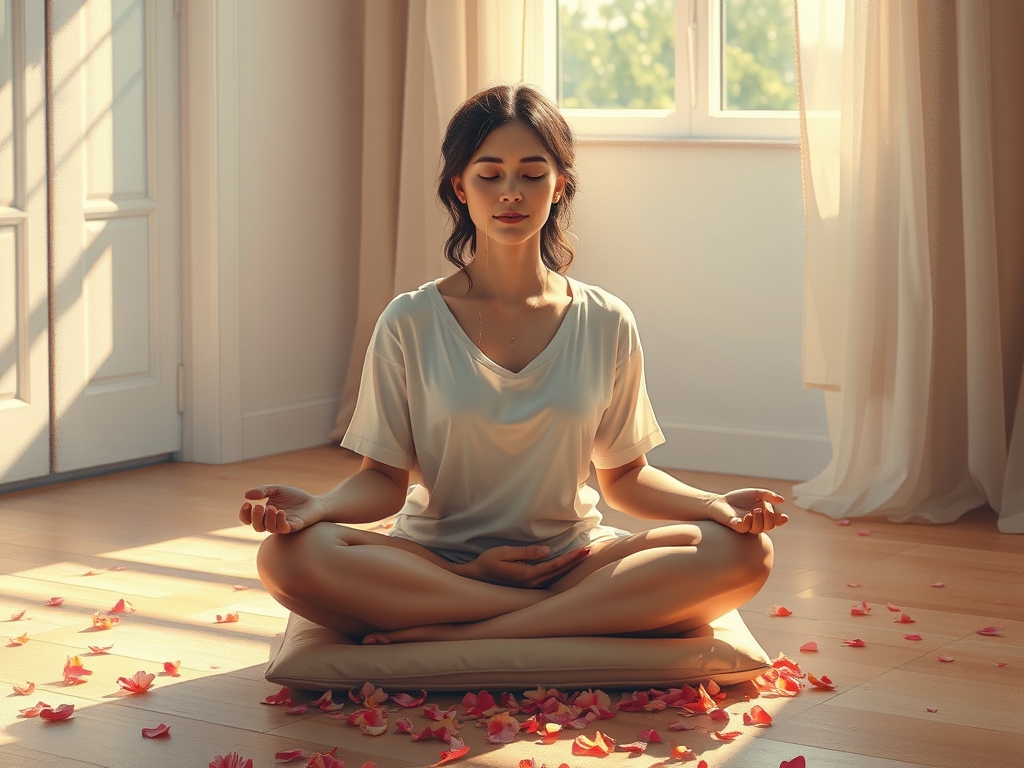
The next night, I sat again. Same thing. About five to eight minutes in, the tears came. This time I let them. I didn’t try to understand or analyze. I just sat and cried and breathed.
This continued for about two weeks. Every meditation session brought tears. Sometimes quiet ones. Sometimes the deep, racking kind. And gradually, things started coming up. Not in meditation itself, but in the hours afterward. Memories. Feelings. Things I’d buried years ago.
The homesickness I never let myself feel when I first came to Canada at nineteen. I’d told myself I was fine, I was strong, I was excited about my new life. And I was those things. But I was also a girl who missed her mother’s cooking and her grandmother’s morning silence and the sound of temple bells from the neighborhood mandir. I’d packed that grief into a box and sat on the lid for fifteen years, and now the box was opening.
The guilt about leaving. My parents never said they were disappointed. They were proud. But I carried a quiet belief that I’d abandoned them, that my ambition had cost them their daughter’s presence during their aging years. That guilt lived in my chest like a small, permanent knot, so constant that I’d stopped noticing it.
The loss of identity. Somewhere between Jaipur and Toronto, between my grandmother’s meditation practice and my software engineering career, I’d lost a part of myself that I didn’t know how to reclaim. The part that believed in something beyond the visible. The part that could sit still and feel connected to something vast.
All of this came up in those two weeks of crying on my meditation cushion. Not as thoughts to analyze, but as feelings to finally feel.
After about the third week, the tears slowed. They didn’t stop completely; they still come sometimes when I meditate. But the intensity softened. And in their place, something new arrived. I don’t want to oversell it, so I’ll describe it simply: warmth. A feeling of warmth in my chest that shows up about ten minutes into meditation and stays with me for a while afterward. Like being held, but from the inside.
Yogananda wrote about this, didn’t he? About the inner experience of divine love that arises when the mind becomes still?
I found this passage after one of my meditation sessions and it made me cry again, but differently:
“The wave of the ocean, beholding its separation from the sea, weeps, not knowing that it is a part of the infinite ocean. So it is with the soul.”Paramahansa Yogananda, “The Divine Romance”
That’s what it felt like. Like I’d been a wave, thinking I was separate, and the meditation was slowly dissolving the illusion. I wasn’t separate from my family. I wasn’t separate from my heritage. I wasn’t separate from the girl who sat beside her grandmother on a quiet morning in Jaipur. She was still in me, had always been in me, and all she needed was for me to sit down and be quiet long enough for her to speak.
I’ve been meditating daily for eight months now. I’ve started learning about Kriya Yoga through Yogananda’s lessons. And last month, I called my grandmother and told her I was meditating. The silence on the phone was so full. Then she said, in Hindi, “It was always waiting for you.”
I’m not the same person I was a year ago. I’m quieter. More grounded. More connected to something I can’t name but can feel every day. The tears were the beginning, not the end. They were the breaking open that let everything else in.
Thank you for being the catalyst. Your episode on Yogananda was the match, but the kindling had been building for fifteen years.
With love and gratitude,
Priya, Toronto
Our Response
Priya, your grandmother’s words, “It was always waiting for you,” might be the most beautiful sentence we’ve ever included in a listener letter.
What you experienced during those first weeks of meditation has a name in contemplative traditions: emotional release. It’s well documented and far more common than most people realize. When you sit still after years of motion, when you finally stop the doing and just be, the body begins to discharge stored emotional material. Tears, trembling, unexpected memories, these are all signs that the system is finally processing what it’s been carrying.
Joseph Murphy would understand this immediately through his framework of the subconscious mind:
“Whatever thoughts, beliefs, opinions, theories, or dogmas you write, engrave, or impress on your subconscious mind, you shall experience them as the objective manifestation of circumstances, conditions, and events.”Joseph Murphy, “The Power of Your Subconscious Mind”
For fifteen years, you were impressing “I’m fine, I don’t miss home, I’ve moved on” onto your subconscious. And for fifteen years, your subconscious was dutifully suppressing the truth. Meditation broke the suppression, not by force, but by creating enough safety and stillness for the truth to surface on its own.
The warmth you describe is significant. In Yogananda’s teachings, it’s a sign of what he called “the inner presence,” the divine awareness that becomes perceptible when the mind’s noise subsides. Whether you interpret it spiritually or psychologically, the experience is real, and it’s the fruit of honest practice.
Your story is a reminder that the path home isn’t always a physical journey. Sometimes it’s sitting on a cushion in Toronto and finding Jaipur still alive in your heart. The grandmother’s practice, the morning silence, the sense of connection to something larger: none of it was lost. It was stored. Waiting. And you found it again, exactly as she said you would.
Eight months of daily practice is a genuine commitment, and the changes you describe, the quietness, the groundedness, the connection, are the natural fruits of that commitment. We’re honored to have played even a small part in the beginning, and we trust the practice will continue to unfold in ways you can’t yet imagine.