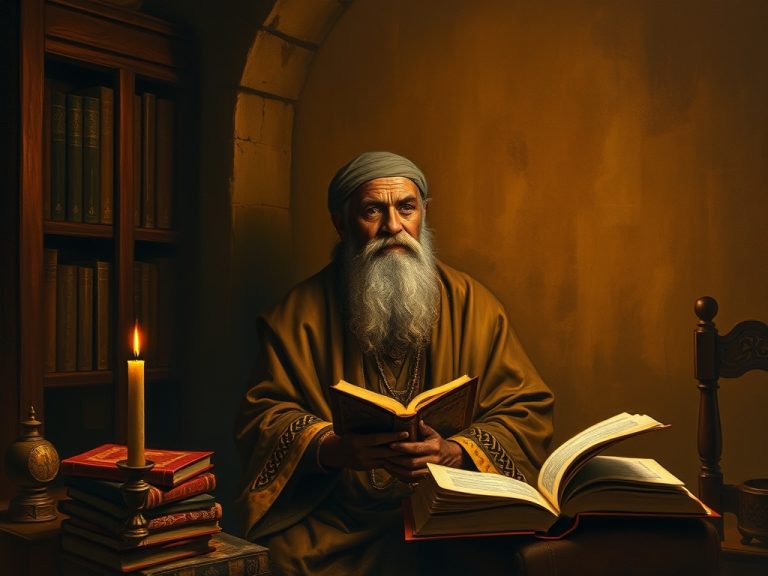
For decades, Abdullah existed only in Neville Goddard’s stories. A tall, dark-skinned man. An Ethiopian rabbi. A teacher who could read minds and who once slammed a door in Neville’s face and told him he was already in Barbados. The stories were vivid, but the man behind them was a ghost. No photograph. No last name. No paper trail.
Until now.
Researchers have spent years trying to identify the man Neville called simply “Abdullah.” The investigation has produced a candidate who fits the profile with striking precision: a baritone music professor, mystic, and teacher of biblical symbolism who operated out of a Manhattan townhouse at the exact address Neville described.
What Neville Told Us
Let’s start with what Neville himself said about his teacher. Across many lectures, he described Abdullah as:
- A black man of Ethiopian Hebrew descent
- A rabbi who taught the Kabbalah and Hebrew
- A resident of 30 West 72nd Street in Manhattan
- Someone with a powerful, commanding voice
- A teacher who could perceive things about people that they didn’t know themselves
- Active in New York during the late 1920s and 1930s
Neville said he studied with Abdullah for approximately seven years, during the period when he lived in his basement apartment at 154 West 75th Street, just a few blocks away.
The Documentary Trail
The identification centers on Dr. Modeste Abda’llah Guillaume, also listed in records as G. M. Abdallah and Guillaume M. Abdallah. Born around 1871 in Algiers, he immigrated to the United States in 1895 and was naturalized in 1902.
Atlantic City: The Early Years
Before arriving in New York, Guillaume ran the Bel Canto Conservatory at 1708 Arctic Avenue in Atlantic City from roughly 1908 to 1923. The 1920 Census lists him as a “music professor” and baritone, aged forty-nine, born in Algiers. His wife was Cora Contee Guillaume.
He was, in other words, a trained baritone singer who taught voice. The powerful, commanding voice that Neville described fits a professional vocalist.
His last public advertisement in Atlantic City appeared on October 8, 1923, in the Atlantic City Press. Shortly after, the trail picks up in Manhattan.
30 West 72nd Street
In September 1923, a baritone named W. Henri Zay purchased the townhouse at 30 West 72nd Street. Both Zay and Guillaume were trained in the Lamperti vocal tradition, connecting them through professional circles. The building housed an eclectic mix of tenants: the Anthroposophical Society, voice studios, and Spiritualist churches.
This is the exact address Neville gave for Abdullah’s residence.
What Guillaume Taught
Guillaume advertised himself as a teacher of subjects that sound remarkably like what Neville described learning from Abdullah:
- “Mystery books of Moses”
- “Materialization of things invisible”
- “Science of Being” and “mastery of control”
- Spiritualist phenomena and psychic development
“Materialization of things invisible” is strikingly close to Neville’s core teaching: that imagination, properly applied, makes the invisible visible. “Mystery books of Moses” aligns with the Kabbalistic and Hebrew instruction Neville described receiving.
The Network Connections
Guillaume’s Atlantic City church incorporated with several individuals, including Bessie B. Payne and Elizabeth M. Maconochie, whose names appear in Unity and New Thought networks. These are the same networks that would later produce many of Neville’s students. The connections aren’t direct proof, but they show Guillaume operating within the exact spiritual ecosystem that Neville inhabited.
The Fellowship of Faiths
One of the most intriguing connections involves a broader documentary context. During the late 1920s and early 1930s, New York hosted various interfaith gatherings where spiritual teachers from different traditions appeared together. The panels included figures from Hindu, Islamic, Jewish, and Christian mystical traditions.
It was at gatherings like these that Paramahansa Yogananda, who would become one of the most famous spiritual teachers of the twentieth century, appeared alongside lesser-known mystics and scholars. The spiritual world of 1920s-1930s New York was small enough that someone like Guillaume, with his background in biblical mysticism and voice training, would have moved through the same circles.
A Seventy Percent Confidence
The researchers who conducted this investigation are careful to note that the identification carries approximately seventy percent confidence. It’s not absolute. There’s no single document that says “Dr. Modeste Abda’llah Guillaume is the man Neville Goddard called Abdullah.”
What there is, instead, is a convergence of evidence:
- The correct address: 30 West 72nd Street
- The correct time period: 1920s-1930s New York
- The correct voice: a trained baritone
- The correct teachings: biblical mysticism, Hebrew, materialization of the invisible
- The correct networks: Unity, New Thought, interfaith spiritual circles
Each piece alone would be suggestive. Together, they build a portrait that matches what Neville described.
Why the Identification Matters
Some people don’t want Abdullah identified. They prefer the mystery. There’s a certain power in a teacher who exists only as a voice in someone else’s stories, a figure who taught the secrets of the universe and then vanished without a trace.
I understand that impulse. But I think the identification actually makes the story more remarkable, not less.
If Abdullah was Guillaume, then he was a man born in Algiers who crossed the Atlantic, built a career as a music teacher, and somewhere along the way developed a system of biblical mysticism powerful enough to produce Neville Goddard. He wasn’t a mythical figure. He was a real person with a real history who did extraordinary things in rented rooms.
That’s more inspiring to me than a legend. Legends are for admiring from a distance. Real people are for learning from.
The Seven Years
Whatever Abdullah’s identity, what Neville received from him was extraordinary. Seven years of daily instruction in the Kabbalah, Hebrew, and the mystical interpretation of scripture. Seven years of walking from his basement apartment on 75th Street to the townhouse on 72nd Street and sitting with a man who could, by Neville’s account, perceive things about people that they didn’t know about themselves.
Abdullah didn’t coddle his students. Neville’s stories about him consistently portray a teacher who was demanding, sometimes blunt, and utterly committed to the principle that imagination is the only reality. The famous Barbados story, where Abdullah slammed the door and told Neville he was “already in Barbados,” isn’t a story about a gentle guru. It’s a story about a teacher who refused to let his student indulge in self-pity.
If that teacher was Guillaume, a Lamperti-trained baritone who’d reinvented himself as a mystic, then the story of American spirituality has an unexpected character at its center: a voice teacher from Algiers who taught Neville Goddard to hear the inner voice of imagination more clearly than the outer voice of circumstance.
The building at 30 West 72nd Street still stands. The Anthroposophical Society, the voice studios, the Spiritualist churches that once operated there are gone. But the teaching that came out of that building is still alive, carried forward by the millions of people who practice what Neville learned there, most of them unaware of the address where it all began.
Neville once described his first meeting with Abdullah. He walked into a room, and before he could introduce himself, Abdullah looked at him and said:
“You are six months late. I have been waiting for you.”
Neville Goddard, recounting his meeting with Abdullah
Whether the man who said those words was Dr. Modeste Abda’llah Guillaume or someone we haven’t yet found, the words changed Neville’s life. And through Neville, they’ve changed the lives of millions.
The search continues. But we’re closer now than we’ve ever been to knowing who stood at 30 West 72nd Street, looked at a young dancer from Barbados, and told him he was already late for the appointment that would reshape his entire existence.