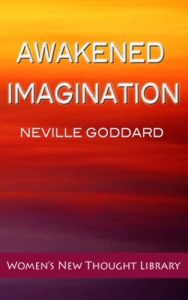
If someone held a gun to my head and said “recommend one Neville Goddard book,” it wouldn’t be Feeling Is the Secret. It would be this one.
I know that’s a controversial choice. Feeling Is the Secret is the popular answer, short, punchy, immediately applicable. But Awakened Imagination does something none of Neville’s other books do: it makes you understand imagination as a faculty, not just a technique. After reading this book, I stopped thinking of imagination as something I do and started experiencing it as something I am. That distinction changed everything.
What Neville Means by “Imagination”
This is crucial, because Neville uses the word differently than we normally do. For most people, imagination means making stuff up, daydreaming, fantasizing, inventing fictions. For Neville, imagination is the creative power of consciousness itself. It’s not a thing you do with your mind. It IS your mind, at its deepest level.
Neville argues that what we call “the real world” (the physical environment, our circumstances, the events of our lives) is not primary. It’s the product of imagination. Imagination creates reality, not the other way around. And “awakened” imagination means becoming conscious of this creative power instead of using it unconsciously, which is what most people do all day long, manufacturing their fears and worries into physical form without realizing it.
“An awakened imagination works with a purpose. It creates and conserves the desirable, and transforms or destroys the undesirable.”
– Neville Goddard, Chapter 1
The Structure and Flow
Awakened Imagination is roughly 100 pages divided into eight chapters, each building on the last. The progression is deliberate: Neville starts with the nature of imagination (Chapter 1), moves to its relationship with Scripture (Chapter 2), explains how it interacts with the “objective world” (Chapter 3), and then gets increasingly practical about how to direct it consciously.
What makes the structure work is that Neville resists the urge to front-load techniques. He builds understanding first. By the time you reach the practical chapters, you’re not just learning what to do, you understand why it works and what’s actually happening when you do it. This is the teaching approach of someone who respects his reader’s intelligence, and it makes the payoff considerably more powerful.
The Chapter That Rearranged My Thinking
Chapter 4, “No One to Change but Self,” is the chapter I’ve reread most. Neville makes an argument that initially sounds narcissistic but gradually reveals itself as profoundly liberating: the only person you ever need to change is yourself. Not because other people don’t matter, but because the “other people” in your experience are reflections of your own consciousness. Change your inner state, and the people around you shift accordingly. Not because you’re controlling them, but because you’re encountering a different aspect of them.
I tested this with a colleague I’d been butting heads with for months. Instead of trying to change their behavior (which hadn’t worked), I spent a week imagining them as cooperative, friendly, easy to work with. I didn’t do anything different externally, no new communication strategies, no forced niceness. I just changed my inner picture.
Within two weeks, the relationship shifted noticeably. Not dramatically. They didn’t become my best friend. But the friction dissolved. Conversations became easier. They started approaching me differently, without any apparent external cause. This experience didn’t prove Neville right in some metaphysical sense, but it convinced me that something real is happening when you change your inner state about another person.
“To attempt to change the world before we change our concept of ourselves is to struggle against the nature of things. There can be no outer change until there is first an inner change.”
– Neville Goddard, Chapter 4: No One to Change but Self
Why This Book Works Better Than the Others
Three reasons.
First, the writing. Awakened Imagination is Neville at his most literary. The prose has a clarity and rhythm that his other books don’t consistently achieve. Sentences land with weight. Paragraphs build to genuine insights. You can tell this was a book he crafted carefully, not a lecture transcribed hastily.
Second, the balance between mysticism and practicality. Your Faith Is Your Fortune is too mystical for many readers. Feeling Is the Secret is almost too practical, all technique, minimal understanding. Awakened Imagination holds both in perfect tension. You understand the metaphysics AND you know what to do with them.
Third, the scope. Despite being short, this book covers more ground than anything else in Neville’s catalog. It addresses imagination as creative power, imagination as a scriptural principle, imagination as a tool for changing relationships, imagination as the mechanism behind prayer, and imagination as the path to what Neville calls “the Promise”, a spiritual awakening that transcends manifestation entirely. All in 100 pages. That’s remarkable economy.
The Biblical Material
I have to address this, because it’s a sticking point for some readers. Neville weaves biblical references throughout every chapter. Adam, Moses, Jacob, Jesus, they all make appearances, reinterpreted as psychological states and operations of consciousness. If you’re allergic to religious language, this is going to be a challenge.
My suggestion: even if you’re not a Bible reader, try to engage with Neville’s interpretations on their own terms. He’s not doing theology. He’s using biblical narratives as a symbolic language for psychological and spiritual processes. When he talks about “Jacob wrestling with the angel,” he means the struggle of holding a new self-concept against the resistance of old habits. When he references “the Promised Land,” he means the state of consciousness where your desired reality is already real.
You don’t have to believe the Bible is sacred to find these interpretations powerful. You just have to be willing to treat the stories as maps of inner experience. If you can do that, Neville’s biblical material transforms from obstacle to asset.
What’s Missing
Troubleshooting. As with most of Neville’s works, there’s little guidance for when things don’t work. What if you can’t sustain the imaginal state? What if your old self-concept reasserts itself? What if weeks pass and nothing changes? Neville’s implied answer is always “persist,” but some readers need more than that. They need specific strategies for overcoming doubt, handling the gap between inner work and outer evidence, and maintaining practice through discouragement.
Neville also doesn’t adequately address the ethical dimensions of using imagination to influence other people. The colleague example I shared, is it ethical to change your inner picture of someone without their knowledge or consent? Neville would say you’re not controlling them, you’re changing yourself. But the line between those two things isn’t always clear, and the book doesn’t explore this complexity.
A Practice Inspired by This Book
Neville describes what I call “living from the end”, occupying the state of your wish fulfilled throughout the day, not just in meditation.
Pick one desire. Identify the version of yourself who already has it. How does that person walk? What do they think about? What do they worry about (or not)? How do they respond to the day’s events?
For one full day, inhabit that version. Not by faking behaviors, but by inwardly assuming the feeling-tone of having already arrived. When a worry arises about the desire, notice it and return to the feeling of fulfillment. When someone asks how you’re doing, let your internal state reflect the person who already has what you want.
This is harder than it sounds and more powerful than you’d expect. The difficulty reveals how much of your day is spent in the old state. The power reveals how quickly reality begins to rearrange itself around a consistently held inner state.
Final Word
If I could only keep one Neville Goddard book and had to give away the rest, I’d keep Awakened Imagination. It’s the complete teaching in miniature, philosophy, method, and vision, woven together by the best writing Neville ever produced. It’s the book that made me stop thinking about imagination and start living from it. Every time I reread it, I find something I missed. That’s the mark of a genuine masterwork.
Enjoyed this review?
Buy Awakened Imagination on Amazon As an affiliate, we may earn a small commission at no extra cost to you.