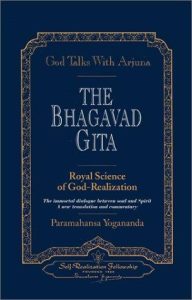
Let me be real about what you’re signing up for: God Talks with Arjuna is a two-volume, 1,600-page commentary on the Bhagavad Gita. It weighs more than some small dogs. It took me four months to read. There were weeks where I could only manage a few pages before needing to stop and think. It’s the most demanding spiritual text I’ve ever attempted.
It’s also the most rewarding.
I say that not as hyperbole but as a straightforward report. Before this book, I’d read the Gita in three different translations and found it beautiful but opaque, like looking at stained glass from the outside. After Yogananda’s commentary, I felt like I’d been let inside the cathedral. Every verse opened into a room I hadn’t known was there.
What Yogananda Does That Other Commentators Don’t
There are hundreds of Gita commentaries, from Shankara to Gandhi to modern scholars. What makes Yogananda’s unique is his insistence that the Gita is primarily a manual of yoga, a practical guide to meditation and spiritual realization, not an abstract philosophical text.
Every verse, in Yogananda’s reading, maps to a specific aspect of inner experience. The battlefield of Kurukshetra is the field of the human body. The armies are the opposing forces of spiritual aspiration and material attachment. The characters represent psychological faculties, Arjuna is the focused mind, Krishna is the indwelling soul, the various warriors are the senses, emotions, and habits that either support or obstruct spiritual progress.
This isn’t arbitrary allegory. Yogananda traces these correspondences with rigorous consistency across all 700 verses, demonstrating that the Gita (read through the lens of yoga practice) contains detailed instructions for every stage of meditation, from beginner breath work to advanced states of cosmic consciousness.
“The ordinary man thinks he is a mortal being; the wise man knows he is Infinite Consciousness dreaming a human dream. The Gita teaches the art of waking from this dream. Not by escaping the world, but by realizing the Dreamer.”
– Paramahansa Yogananda, Commentary on Chapter 2, Verse 11
The Chapters That Stopped Time
Yogananda’s commentary on Chapter 2 of the Gita (Sankhya Yoga) is a masterwork within a masterwork. This is where Krishna first instructs Arjuna in the nature of the soul, its immortality, its distinction from the body, its relationship with the Absolute. Yogananda’s commentary on these verses is so detailed and so experiential that you realize he’s not interpreting from the outside. He’s describing what he’s seen from the inside.
His treatment of verse 2:47 (the famous “You have a right to action, but not to its fruits”) is the best I’ve ever read. Most commentators treat this as a prescription for selfless action. Yogananda goes deeper. He argues that attachment to results is what keeps consciousness bound to the material plane. Not because results are bad, but because attachment to them creates a cycle of desire and disappointment that prevents the mind from settling into its natural state of peace. Action without attachment isn’t sacrifice, it’s liberation.
Chapter 6 (Dhyana Yoga), on meditation practice, is where the book becomes most directly practical. Yogananda’s commentary on the meditation verses includes specific instructions for body posture, breath regulation, energy movement, and consciousness concentration that go far beyond what’s available in any ordinary yoga class. He’s essentially using the Gita as a framework for teaching advanced meditation technique, and the detail he provides suggests decades of personal practice informing every line.
The Scale of Ambition
What Yogananda attempts here is staggering in scope. He isn’t just explaining the Gita, he’s attempting to demonstrate that it contains a complete science of consciousness, a comprehensive map of the spiritual journey from initial seeking to final realization. Every verse adds a piece to this map. By the end, if you’ve been reading carefully, you have not just an understanding of the Gita but an understanding of the entire yogic path.
“Each stanza of the Gita is not a mere statement of philosophy, but a living truth to be realized in the laboratory of the body through the scientific techniques of yoga.”
– Paramahansa Yogananda, Introduction
The ambition is matched by the execution, mostly. Yogananda sustains the depth and consistency of his commentary across all eighteen chapters: a remarkable feat for a work this long. There are very few places where the commentary feels thin or perfunctory. He takes each verse as seriously as every other, finding meaning in passages that many commentators skim.
The Difficulties
The most obvious difficulty is length. 1,600 pages is a commitment that will deter most readers, and rightfully so. This isn’t a book for casual interest. It’s a book for people who are genuinely committed to understanding the Gita at the deepest level and are willing to invest months of sustained attention.
The commentary also assumes familiarity with yogic concepts (chakras, prana, kundalini, samadhi, the three gunas) that aren’t always defined. If you don’t have this background, you’ll spend a lot of time confused. I’d strongly recommend reading the Autobiography first, ideally supplemented by a basic introduction to yoga philosophy.
Yogananda’s allegorical method, while consistently applied, can feel forced in places. Not every verse of the Gita lends itself naturally to a yogic meditation interpretation, and there are passages where Yogananda’s commentary seems to be reaching for a correspondence that the text doesn’t straightforwardly support. This is the risk of any systematic allegorical reading, the system can become a Procrustean bed.
Finally, the devotional framework is pervasive. Yogananda reads the Gita as a devotional text, a love letter from God to the seeking soul. If you prefer your Gita as philosophy or ethics, this reading will feel foreign and occasionally sentimental.
A Practice Inspired by This Book
Yogananda’s commentary on the Gita’s meditation verses suggests a practice I’ve adapted for daily use:
Sit with your spine straight and your eyes gently closed, attention directed to the point between your eyebrows (what Yogananda calls “the spiritual eye”). Take five slow, deep breaths, inhaling through the nose and exhaling through the mouth. With each exhale, release one layer of tension or concern, let each breath carry something out.
After the five breaths, let your breathing return to normal. Keep your attention at the point between the eyebrows. Don’t force it, hold it there lightly, the way you’d hold a small bird. When attention wanders, gently return it. That’s the whole practice.
Do this for fifteen minutes daily. According to Yogananda, the point between the eyebrows is the seat of concentration and spiritual perception in the body. Directing attention there consistently, over time, develops a capacity for inner stillness that becomes the foundation for deeper meditation. After six months of this practice, I can confirm that something does develop at that point, a quality of calm, focused awareness that wasn’t there before.
Who Needs This Book
If you’re a serious student of the Bhagavad Gita and want the deepest, most comprehensive commentary available from the yogic tradition, this is it. Period. Nothing else comes close in terms of depth, consistency, and practical applicability.
If you’re a devoted practitioner of Yogananda’s teachings and want to understand the scriptural foundation of Kriya Yoga, this is essential reading.
If you’re casually curious about the Gita, start elsewhere. Eknath Easwaran’s translation is more accessible. Stephen Mitchell’s is more literary. Come to Yogananda when you’ve outgrown those and want to go all the way in.
This isn’t a book I recommend lightly. But for the right reader, at the right time, it’s a book that can restructure your entire understanding of spiritual practice. It did that for me, and I suspect it will keep doing it for as long as I keep returning to it, which, given its depth, could be the rest of my life.
Enjoyed this review?
Buy God Talks with Arjuna: The Bhagavad Gita on Amazon As an affiliate, we may earn a small commission at no extra cost to you.