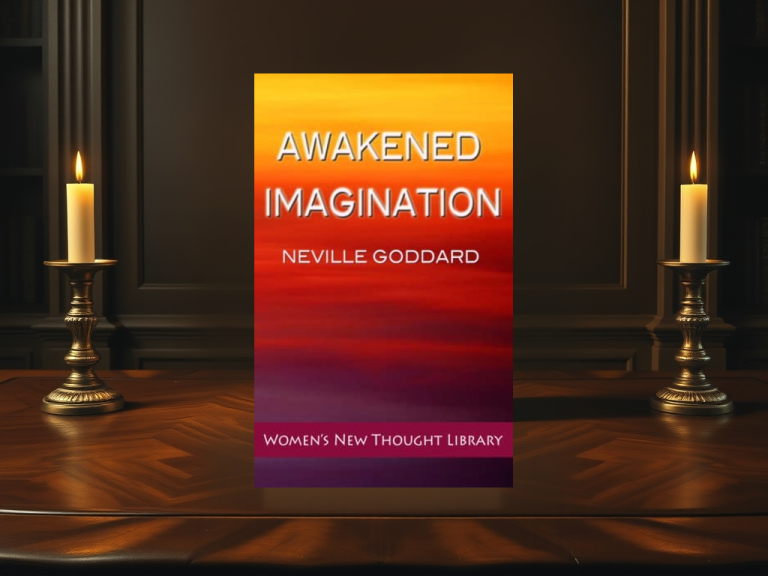
When people ask me where to start with Neville Goddard, I usually recommend Feeling Is the Secret for its brevity or Awakened Imagination for its beauty. But the book I’ve actually reread most, the one I keep coming back to when I’m struggling to apply the principles, when the gap between theory and practice feels unbridgeable, is The Power of Awareness.
It’s not his shortest. It’s not his most lyrical. But it might be his most complete. In about 160 pages, Neville builds his entire teaching from the ground up, consciousness as the only reality, assumption as the creative act, persistence as the bridge between inner state and outer fact, and does it with a clarity and structure that his other books don’t match.
Let me walk through it chapter by chapter, because the progression itself is the teaching.
Chapters 1-4: The Foundation
Neville opens by establishing his fundamental premise: consciousness is the only reality, and the world you experience is its reflection. “I AM” is not a statement about your personality or circumstances: it’s the name of consciousness itself, the one unchanging thing that underlies every experience you’ve ever had.
Chapter 3, “Power of Assumption,” introduces the mechanism. Your assumptions about yourself and the world aren’t passive observations, they’re creative acts. Assume you’re poor and you’ll act, decide, and perceive in ways that maintain poverty. Assume you’re prosperous and the same faculties reorganize around abundance. The assumption comes first; the evidence follows.
Chapter 4, “Desire,” reframes wanting as information. A desire isn’t a sign that you lack something, it’s a signal from consciousness about what wants to emerge through you. Neville says the feeling of wanting is itself evidence that fulfillment is possible; the desire wouldn’t arise if the consciousness creating your reality couldn’t deliver it.
“Assume the feeling of your wish fulfilled and observe the route that your attention follows. It will constantly return to your fulfilled desire, provided you maintain the assumption.”
– Neville Goddard, Chapter 4: Desire
Chapters 5-9: The Method
Here’s where the book earns its keep. Chapter 5, “The Truth That Sets You Free,” presents the core practice: identify the state of consciousness associated with your fulfilled desire, assume that state as your present reality, and persist in it regardless of contradictory evidence from the senses.
Chapter 6, “Attention,” explains why most people fail at this. Your attention habitually returns to the state you’re trying to leave. You assume prosperity, then worry about a bill. You assume health, then notice a symptom. The practice isn’t assuming the new state once, it’s redirecting attention to it every time the old state pulls you back. This is where will and discipline enter the picture.
Chapter 7, “Attitude,” is one of Neville’s most practical. He defines attitude as your emotional relationship to a given state, the difference between thinking about being wealthy and feeling wealthy. The attitude is the creative element. Two people can hold the same thought with different attitudes, and they’ll get different results. This distinction finally clarified for me why affirmations alone often fail: the words are correct but the attitude behind them is wrong.
Chapters 8 and 9 cover renunciation and preparation, renouncing the old state (not physically, but mentally, by refusing to give it your attention and feeling) and preparing the consciousness for the new one. These chapters are shorter but essential. They address the transition period between “I know what I want to feel” and “I actually feel it consistently.”
Chapters 10-15: The Complications
This is where The Power of Awareness sets itself apart from Neville’s other books. Instead of stopping at “assume the state and persist,” he addresses the real difficulties that practitioners encounter.
Chapter 10, “Creation,” explains the time delay between assumption and manifestation, and why that delay trips people up. Chapter 11, “Interference,” tackles doubt head-on, acknowledging that maintaining an assumption in the face of contradictory evidence is genuinely hard, and offering strategies for handling doubt without letting it collapse your practice.
Chapter 12, “Subjective Control,” is the chapter I consult most often. Neville explains that you don’t need to control external circumstances. Only your own subjective state. This sounds obvious, but in practice, most people expend enormous energy trying to manipulate the world while neglecting the one thing they can actually control: what they’re assuming right now, in this moment.
“Man’s chief delusion is his conviction that there are causes other than his own state of consciousness. All that befalls a man (all that is done by him, all that comes from him) happens as a result of his state of consciousness.”
– Neville Goddard, Chapter 1: I Am
Chapters 16-27: The Applications
The final third applies the principles to specific situations: failure and success, faith, destiny, reverence, and (crucially) other people. Neville’s chapter on how to change others by changing your assumption about them (Chapter 22, “Whom to Forgive”) is the most ethically nuanced thing he ever wrote. He argues that forgiving someone isn’t about excusing their behavior, it’s about releasing the negative assumption you hold about them, which is the only thing actually binding you to the unpleasant experience.
Chapter 24, “Failure,” addresses what happens when the techniques don’t work. Neville’s answer is characteristically direct: you failed to persist. You assumed the state but didn’t maintain it. The assumption collapsed, and with it, the creation. His advice isn’t “try harder”, it’s “try again, and this time, persist longer.” This may sound dismissive, but in practice, I’ve found it accurate. The times my assumptions haven’t produced results have almost always been times I gave up too soon or let doubt erode the assumed state before it could solidify.
What Makes This Book Special
Structure. Pure and simple. The Power of Awareness is the only Neville book that builds its argument systematically from first principles to practical application to troubleshooting. You can read it front to back and emerge with a complete understanding of the teaching and a clear sense of how to practice it.
His other books give you pieces of the puzzle. This one gives you the whole picture, with each piece in its proper place.
Weaknesses
The writing, while clear, isn’t as beautiful as Awakened Imagination. Some chapters are more workmanlike than inspired. The biblical references, while less dominant than in Your Faith Is Your Fortune, still appear regularly and may alienate secular readers.
And Neville’s absolutism is present throughout. Consciousness is the ONLY reality. Assumption is the ONLY creative act. There’s no room for genes, environment, systemic factors, or plain luck. This purity of vision is either Neville’s greatest strength or his greatest limitation, depending on your own experience and philosophical inclinations.
A Practice Inspired by This Book
Chapter 6’s teaching on attention suggests a practice that’s brutally simple and surprisingly powerful:
Choose one desire. Define the state of consciousness that corresponds to having it (not wanting it, having it). For one full day, every time you notice your attention, check: am I in the state of having, or the state of wanting? Each time you catch yourself wanting, gently redirect to having. Don’t force. Don’t analyze. Just shift.
Track how many times you make this shift in a single day. Most people are stunned by the number, dozens, sometimes hundreds of redirections needed before the “having” state starts to feel natural. This isn’t a sign of failure. It’s a measure of how entrenched the old state is. Each redirection weakens it. Given enough persistence, the new state becomes default.
Try this for one day first. If the number of required shifts feels overwhelming, that’s actually excellent feedback. It shows you exactly how much of your day is spent unconsciously reinforcing the state you want to leave. That awareness alone, even before any manifestation occurs, is transformative.
The Final Word
Five stars. Not because it’s flawless, but because it’s the most complete and usable version of Neville’s teaching in a single volume. If you’re going to read one Neville Goddard book (and especially if you’re going to practice one) make it this one. Feeling Is the Secret will inspire you. Awakened Imagination will move you. But The Power of Awareness will equip you. And in the end, equipment is what you need.
Enjoyed this review?
Buy The Power of Awareness on Amazon As an affiliate, we may earn a small commission at no extra cost to you.