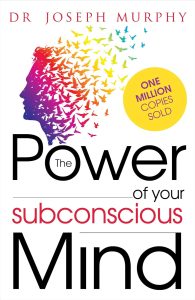
I bought this book at an airport in 2019 because I had a four-hour flight and nothing to read. The cover looked dated. The title sounded like something my aunt would recommend. I expected to skim fifty pages and fall asleep.
Instead, I underlined half the book, missed my connecting flight announcement, and spent the next three months testing every technique Joseph Murphy described. Some of them worked so well it genuinely scared me.
What Joseph Murphy Is Actually Arguing
The core thesis is straightforward: your subconscious mind is a powerful creative engine that takes your habitual thoughts and feelings as instructions, then works to materialize them in your life. Murphy calls the conscious mind the “gardener” and the subconscious the “soil”, whatever you plant grows, regardless of whether it’s a flower or a weed.
Where Murphy distinguishes himself from other writers in this tradition is his relentless practicality. Nearly every chapter includes a specific technique, a prayer, a visualization, a mental movie, a sleep method. He doesn’t just tell you the subconscious is powerful. He hands you a dozen different ways to direct it.
“The law of your mind is this: You will get a reaction or response from your subconscious mind according to the nature of the thought or idea you hold in your conscious mind.”
– Joseph Murphy, Chapter 2
The Chapters That Actually Deliver
Chapter 3, on the miracle-working power of the subconscious, was where I first sat up straight. Murphy describes a technique he calls the “mental movie method”, constructing a vivid scene of your desired outcome and playing it repeatedly in a relaxed state, with strong positive emotion. This isn’t visualization as we usually understand it (staring at a picture and hoping). It’s closer to self-hypnosis, and Murphy’s instructions are precise enough to actually follow.
Chapter 8, on how the subconscious removes mental blocks, is arguably the most useful chapter in the book. Murphy addresses something most manifestation authors ignore: what happens when you try to impress a positive belief on your subconscious and it just… doesn’t take. He explains the concept of counter-intentions (conflicting beliefs that cancel out your conscious desires) and offers methods for dissolving them. This chapter alone was worth the cover price.
The chapters on health and healing (Chapters 12-13) are where Murphy’s faith in subconscious power reaches its peak. He shares case after case of people who allegedly healed serious conditions through directed subconscious belief. I’ll be honest (some of these stories strain credibility. But the underlying principle) that chronic stress and negative belief patterns contribute to physical illness, is well-supported by modern psychoneuroimmunology research, even if Murphy’s specific examples might be embellished.
The Real Stories That Hit Different
Murphy peppers the book with anecdotes from his counseling practice, and some of them are genuinely compelling. A woman who’d been passed over for promotion after promotion who changed her inner dialogue and got offered a position she hadn’t even applied for. A man with chronic insomnia who used the sleep technique and was sleeping soundly within a week. A couple on the verge of divorce who shifted their mental patterns toward appreciation and reconciled.
Are these stories verifiable? No. Could they be exaggerated or composited? Absolutely. But they serve an important purpose: they make the techniques concrete. Instead of abstract theory, you see what application looks like in real situations. And frankly, several of these anecdotes mirror my own experience closely enough that I’m inclined to give Murphy the benefit of the doubt.
“Never finish a negative statement; reverse it immediately and wonders will happen in your life.”
– Joseph Murphy, Chapter 3
That quote became a daily practice for me. Catching myself mid-sentence, “I’ll never be able to afford – “, and stopping. Reversing. Choosing a different ending. It sounds almost too simple, but after a month of doing this consistently, I noticed I was calmer, more optimistic, and (this is the strange part) opportunities started appearing that hadn’t been there before. Or maybe they had, and I was finally in a state to notice them.
Where the Book Shows Its Age
Let’s talk about the problems, because there are several.
The writing style is repetitive. Murphy makes the same point (that the subconscious accepts what you consciously impress upon it) in essentially every chapter. By Chapter 10, you’ve heard the gardener-and-soil metaphor enough times to want to throw the book into actual soil. A strong editor could’ve cut this book by a third without losing anything.
The gender dynamics are firmly 1960s. Women in Murphy’s examples are usually trying to find husbands or improve their marriages. Men are trying to get promoted or make money. It’s not malicious, but it’s noticeable and occasionally cringe-worthy. You have to read past the cultural context to get to the universal principles.
Murphy also has a habit of making claims without qualification. He suggests that the right use of the subconscious mind can heal virtually any condition, resolve any problem, attract any outcome. There’s no acknowledgment of systemic barriers, mental health conditions that require professional treatment, or situations where positive thinking alone is insufficient. This isn’t just dated, it’s potentially harmful if someone takes it as a reason to skip medical care or ignore real structural problems in their life.
And the religious framework (Murphy was a minister) is woven throughout. He frequently equates subconscious principles with biblical teachings. If you’re comfortable with that, it adds depth. If you’re not, it can feel like you’re being preached to rather than taught.
How It Compares to Neville Goddard
People always ask me whether to read Murphy or Neville first. Here’s my honest take: Murphy is the better starting point. He’s warmer, more practical, more methodical. He gives you multiple techniques and explains each one step by step. Neville is more profound but also more cryptic, he assumes you already understand the basics and builds from there.
Think of Murphy as the thorough instructor who walks you through every drill. Neville is the master who demonstrates once, perfectly, and expects you to have been paying attention.
A Practice Inspired by This Book
Murphy’s “thankful sleep” technique is the one I still use regularly. Here’s the version I adapted from Chapter 5:
Before bed, think of three things you want to experience in your life. Not someday, but as if they’ve already happened. For each one, form a single sentence of gratitude. “I’m so grateful that _____ happened.” Say each sentence slowly, mentally, feeling genuine thankfulness. Not forcing it, but finding the warmth of it.
Then let them go. Don’t rehearse, don’t analyze, don’t wonder if it’s working. Just feel the combined gratitude and drift to sleep on that feeling.
Do this every night for two weeks. Keep a simple journal of anything unusual that shows up, synchronicities, unexpected opportunities, shifts in mood or confidence. You may be surprised how quickly the subconscious starts responding once you give it clear, emotionally-charged material to work with.
The Honest Verdict
Is The Power of Your Subconscious Mind worth the hype? Mostly, yes. It’s not a perfect book, it’s repetitive, occasionally naive, and trapped in some mid-century assumptions that haven’t aged well. But the core teaching is sound, the techniques are practical, and it remains one of the most accessible entry points into subconscious reprogramming that I’ve found.
I’ve given this book to people who’d never read anything in this space before. Most of them finished it. Most of them tried at least one technique. And most of them came back wanting to read more. That’s a pretty strong endorsement for a book with an airport-paperback cover and a title that sounds like an infomercial.
Just read past the dated parts, try the techniques before judging them, and remember that Murphy’s real gift wasn’t originality. It was clarity. He took ideas that had been floating around esoteric circles for decades and made them accessible to ordinary people. That’s not a small thing.
Enjoyed this review?
Buy The Power of Your Subconscious Mind on Amazon As an affiliate, we may earn a small commission at no extra cost to you.