The Book That Steve Jobs Read Every Year (And Why You Should Too)
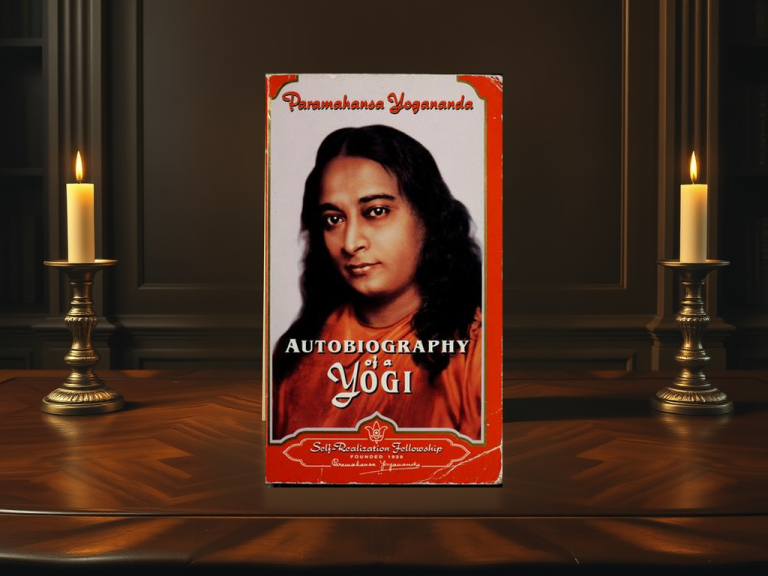
I picked up Autobiography of a Yogi expecting a gentle spiritual memoir. Something soothing and vaguely inspirational. What I got instead was a book that cracked open my understanding of what’s possible in human consciousness and left me sitting on my couch staring at the wall for twenty minutes afterward.
Rating: 5 out of 5 stars
First published in 1946, this is Paramahansa Yogananda’s account of his life from childhood in India through his years establishing the Self-Realization Fellowship in America. On the surface it’s a biography. Underneath, it’s a manual for understanding the deeper mechanics of consciousness, wrapped in some of the most extraordinary stories you’ll ever read.
What Makes This Book Different
Most spiritual books deal in concepts. Yogananda deals in experiences. He doesn’t tell you that miracles are possible and ask you to take it on faith. He describes specific events he witnessed or participated in, names the people involved, and lets you decide what to make of it.
His encounter with his guru, Sri Yukteswar, forms the emotional backbone of the book. The relationship between teacher and student is rendered with such tenderness and specificity that it becomes a teaching in itself about what spiritual mentorship can look like.
“The season of failure is the best time for sowing the seeds of success.”Paramahansa Yogananda
Yogananda’s prose has a quality I can only describe as luminous. Even when he’s describing ordinary events, there’s a quality of presence in the writing that makes you slow down. The book resists skimming. It asks you to read at the pace of contemplation.
The Chapters That Changed Me
Chapter 14, “An Experience in Cosmic Consciousness,” is one of the most remarkable pieces of spiritual writing in any language. Yogananda describes his guru tapping him on the chest and triggering an experience of expanded awareness that dissolves the boundaries between self and universe. The language strains to capture something beyond language, and somehow succeeds.
Chapter 26, on Kriya Yoga, provides the clearest public explanation of the technique that Yogananda considered the crown jewel of his teaching. He doesn’t give full instruction (that requires initiation), but he explains the principles clearly enough that you understand what Kriya is designed to accomplish.
The later chapters, covering Yogananda’s years in America, are fascinating for a different reason. Watching an Indian mystic navigate 1920s and 1930s America, dealing with skeptics, building organizations, giving lectures to packed halls, is both inspiring and humanizing.
What Practitioners of Neville and Murphy Will Find Here
If you come to this book from a Neville or Murphy background, you’ll find both familiar territory and genuinely new dimensions. Yogananda’s understanding of consciousness as the fundamental reality aligns with what Neville taught:
“You are not a human being having a spiritual experience. You are a spiritual being having a human experience.”Paramahansa Yogananda
But Yogananda goes further into the mechanics of meditation, energy, and the subtle body than either Neville or Murphy ever did. His framework includes the chakras, the astral plane, and detailed cosmology. Whether or not you adopt his full worldview, the meditation practices he points toward are powerful complements to the imagination work of Neville and the affirmation work of Murphy.
Who This Book Is For
- Anyone who wants to understand the deeper tradition behind modern manifestation teaching
- Readers who are ready for a spiritual text that challenges Western materialist assumptions directly
- Practitioners looking to add meditation depth to their existing Neville/Murphy practice
- Anyone curious about the historical roots of yoga and meditation in the West
Who Might Struggle With It
- Readers who need everything to be scientifically verifiable (some chapters describe events that defy conventional physics)
- People looking for a quick, practical manifestation guide (this is a 500-page spiritual autobiography)
- Those who are uncomfortable with the guru-disciple tradition
Key Takeaways
- Consciousness is not produced by the brain. It is the fundamental substrate of reality. Everything Neville and Murphy taught rests on this premise, and Yogananda demonstrates it through lived experience.
- Meditation is not optional for deep spiritual development. Yogananda considered it the essential practice, and the book makes a compelling case for why.
- The relationship between teacher and student is a sacred technology. Yogananda’s relationship with Sri Yukteswar demonstrates how a true teacher accelerates growth in ways that books alone cannot.
- East and West can meet. Yogananda spent his life building bridges between Indian spiritual tradition and Western pragmatism. His success suggests the synthesis is not only possible but necessary.
A Practice Inspired by This Book
After reading Autobiography of a Yogi, I added five minutes of Hong-Sau meditation (Yogananda’s basic concentration technique) to my morning routine. You focus on the breath and silently say “Hong” on the inhale, “Sau” on the exhale. It’s simple. It’s ancient. And it deepens the stillness that precedes my Neville and Murphy work beautifully.
Try it for one week before your regular practice and see if it changes the quality of your sessions. That’s the kind of practical gift this book keeps giving, long after you’ve turned the last page.
This is one of those rare books that earns the word “classic.” It doesn’t just inform you. It transforms you, if you let it. Read it slowly. Read it more than once. And pay attention to what it stirs in you, because what it stirs is the point.
Enjoyed this review?
Buy This Book on Amazon As an affiliate, we may earn a small commission at no extra cost to you.