The Talks That Show You Yogananda as a Living Teacher
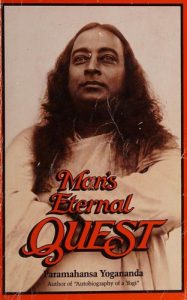
Reading Yogananda’s formal books, you get the philosopher, the mystic, the carefully composed spiritual author. Reading Man’s Eternal Quest, you get the man himself, standing on a stage, speaking to real people about real questions, with all the warmth and spontaneity and humor that a live teacher brings.
Rating: 4 out of 5 stars
Published posthumously in 1975 by Self-Realization Fellowship, this is the first volume of Yogananda’s collected talks and essays. It draws from lectures he gave throughout the 1930s and 1940s to audiences at his temples, retreats, and public gatherings. The spoken quality of these pieces makes them feel immediate in a way his more polished books sometimes don’t.
What You’ll Find Here
The book covers an enormous range of topics: meditation, the nature of God, reincarnation, health, diet, relationships, willpower, the afterlife, and much more. Each talk stands alone, so you can open the book at any chapter and read without needing prior context.
“The soul loves to meditate, for in contact with the Spirit lies its greatest joy.”Paramahansa Yogananda
The variety is both a strength and a potential drawback. There’s no single through-line or argument being built. It’s more like sitting in the front row of Yogananda’s Sunday services for a year, hearing whatever he’s moved to talk about that day. Some talks will speak directly to where you are in your practice. Others might not resonate until you revisit them months or years later.
The Talks That Affected Me Most
“How to Be a Smile Millionaire” is vintage Yogananda: practical, warm, slightly eccentric, and deeply wise. He makes the case that cultivating genuine inner joy is more valuable than any external achievement, and he gives specific methods for doing so.
“Recharging Your Body Battery” contains Yogananda’s Energization Exercises in their most accessible form. These are physical techniques for channeling energy through the body using will and concentration. They’re a remarkable complement to seated meditation and to the more passive techniques of Neville and Murphy.
“The Art of Getting Along with Others” surprised me with its practicality. Yogananda addresses jealousy, criticism, and conflict with a directness that feels almost modern. His advice isn’t mystical here. It’s grounded and human.
“Ridding the Consciousness of Worry” is one I return to often. Yogananda’s approach to worry is neither dismissive (“just don’t worry”) nor complicated. He acknowledges worry as a real mental habit and gives specific techniques for dissolving it, including a meditation practice specifically designed to address anxious thoughts.
How It Connects to Neville and Murphy
The talk on “The Power of Thought” brings Yogananda closest to Murphy’s territory. He describes thought as a creative force that shapes external reality, using language that Murphy readers will recognize immediately. The difference is context: Murphy presents this as a technique for getting what you want. Yogananda presents it as a spiritual responsibility.
“Change your thoughts if you wish to change your circumstances. Since you alone are responsible for your thoughts, only you can change them.”Paramahansa Yogananda
Several talks on meditation provide the depth that Neville and Murphy assume but don’t teach. If you’ve ever felt that your SATS sessions would benefit from a calmer, more focused mind, the meditation guidance in this book is exactly what you need. Yogananda taught meditation as the foundation for all other spiritual practice, and these talks explain why.
Who This Book Is For
- Readers who already love Yogananda and want more of his voice
- Those who prefer the informal, spoken quality of lectures over formal prose
- Practitioners seeking meditation instruction to complement their Neville/Murphy work
- Anyone interested in a comprehensive overview of Yogananda’s thought across many topics
Who Might Struggle With It
- Readers looking for a focused, single-topic book (this covers too many subjects for that)
- Those who want practical manifestation techniques specifically (Yogananda’s emphasis is on spiritual development more broadly)
- People uncomfortable with devotional language or references to God
Key Takeaways
- Meditation is the foundational practice. Everything else, including manifestation and affirmation, works better when built on a base of mental stillness.
- Joy is not a result of external circumstances but a quality of consciousness that can be cultivated deliberately.
- Willpower is a trainable faculty, not a fixed resource. Yogananda’s Energization Exercises are one method for strengthening it.
- Thought is creative force. This aligns Yogananda with Murphy and Neville while placing the teaching in a broader spiritual context.
A Practice From This Book
Try Yogananda’s simple worry-dissolving technique from the talk on worry. When a worrying thought arises, don’t engage with it. Instead, immediately bring your attention to the point between your eyebrows (the spiritual eye) and hold it there for thirty seconds while breathing slowly. The worry thought requires your attention to survive. By redirecting attention to a fixed point, you starve the worry of its fuel.
Practice this five times today whenever worry arises. By evening, you’ll notice that the worry has less grip. Not because you’ve solved the problem, but because you’ve trained your attention to go somewhere other than the worry circuit.
This book is a treasure chest. You won’t use every gem in it, but the ones that speak to you will become regular companions in your practice. Keep it accessible. Open it when you need guidance, encouragement, or simply the presence of a teacher who understood both the heights of mystical experience and the mundane struggles of daily life.
Enjoyed this review?
Buy This Book on Amazon As an affiliate, we may earn a small commission at no extra cost to you.