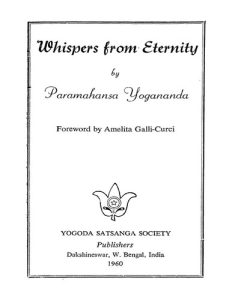
Not a Book You Read, But a Book You Pray
I’ve been sitting with this review for weeks because Whispers from Eternity resists the usual review format. It’s not a teaching book. It’s not a technique manual. It’s not even, in the conventional sense, a book of poetry, though it contains some of the most beautiful spiritual verse I’ve encountered in English.
Rating: 4.5 out of 5 stars
Published in 1929 and revised in 1949, Whispers from Eternity is Yogananda’s collection of what he called “spiritualized prayers and universal demands.” Each piece is a direct address to the Divine, written from a state of deep meditation and devotion. They range from short invocations to extended poetic meditations on God, nature, consciousness, and the soul.
What Makes This Book Extraordinary
Most prayer books feel formal. Dutiful. Like letters written to a distant authority. Yogananda’s prayers feel like conversations with a beloved friend who happens to be infinite. There’s an intimacy here that’s almost startling.
“I will be calmly active. I will be actively calm. I will not become lazy and mentally ossified. Nor will I be foolishly overactive.”Paramahansa Yogananda
The prayers cover the full range of human experience: loneliness, longing, joy, gratitude, doubt, surrender, and ecstasy. Yogananda doesn’t pretend to be beyond struggle. Some of the most moving pieces are the ones where he acknowledges his own human frailty and asks for the strength to persist.
How to Use This Book
Don’t read it cover to cover. Open it when you need it. When you’re struggling with doubt, find a prayer about faith. When you’re feeling disconnected from your practice, find one about devotion. When you’re overwhelmed with gratitude, find one that gives that gratitude a voice.
I keep this book by my meditation seat and open it before my morning practice. I read a single prayer slowly, let it sink in, and then begin my sitting. It changes the quality of the meditation noticeably. The prayer opens a channel that the silence then deepens.
For practitioners of Neville and Murphy, this might seem like a departure. Neither Neville nor Murphy used devotional prayer in this style. But there’s a powerful overlap: Yogananda’s prayers are acts of feeling. They’re not petitions. They’re states. Each prayer is an invitation to feel a particular quality of consciousness, whether it’s peace, courage, love, or surrender.
“Teach me to find Thy presence on the altar of my constant peace.”Paramahansa Yogananda
In that sense, Yogananda’s prayers function similarly to Neville’s “feeling of the wish fulfilled.” They bring you into a state. And once you’re in the state, the state does its creative work.
The Standout Prayers
“In the Temple of Silence” is perhaps the most beloved piece in the collection. It’s an extended meditation on inner stillness that reads like a guided visualization into the deepest part of your being.
“Demand for Divine Wealth” is fascinating for manifestation practitioners. Yogananda frames abundance not as something to be attracted but as something to be accepted from a universe that is inherently generous.
“Prayer for a Specific Purpose” shows Yogananda’s practical side. It’s a structured prayer that readers can adapt for their own desires, combining devotion with specific intention.
Who This Book Is For
- Practitioners who want to add a devotional dimension to their practice
- Anyone who resonates with the bhakti (devotional love) approach to spirituality
- Readers who find that poetry and prayer open them in ways that prose instruction doesn’t
- Meditators looking for something beautiful to read before sitting
Who Might Struggle With It
- Readers who prefer a secular or purely psychological framing
- Those looking for practical techniques (this is not a how-to book)
- People uncomfortable with direct address to God/the Divine
Key Takeaways
- Prayer can be an act of feeling, not just asking. This connects Yogananda’s devotional approach to Neville’s principle of “feeling the wish fulfilled.”
- Devotion and technique are not opposites. They can work together, with devotion opening the heart and technique directing the mind.
- The Divine is intimate, not distant. Yogananda’s entire approach is based on a personal, loving relationship with the Infinite.
A Practice Inspired by This Book
Choose one prayer or passage from Whispers from Eternity (or write your own in Yogananda’s style). Read it aloud before your evening practice. Let the words resonate in your chest, not just your mind. Then close the book and sit in silence for three minutes before beginning your SATS or affirmation work.
Notice whether the devotional opening changes the quality of what follows. In my experience, it softens the mind and opens the heart in a way that makes the subsequent impression work go deeper. It’s like warming the soil before planting the seed.
This isn’t a book for everyone. But for those it speaks to, it speaks with a voice that feels ancient, personal, and achingly beautiful. Keep it close. Open it often. Let it remind you that this work isn’t just about getting things. It’s about remembering what you are.
Enjoyed this review?
Buy This Book on Amazon As an affiliate, we may earn a small commission at no extra cost to you.