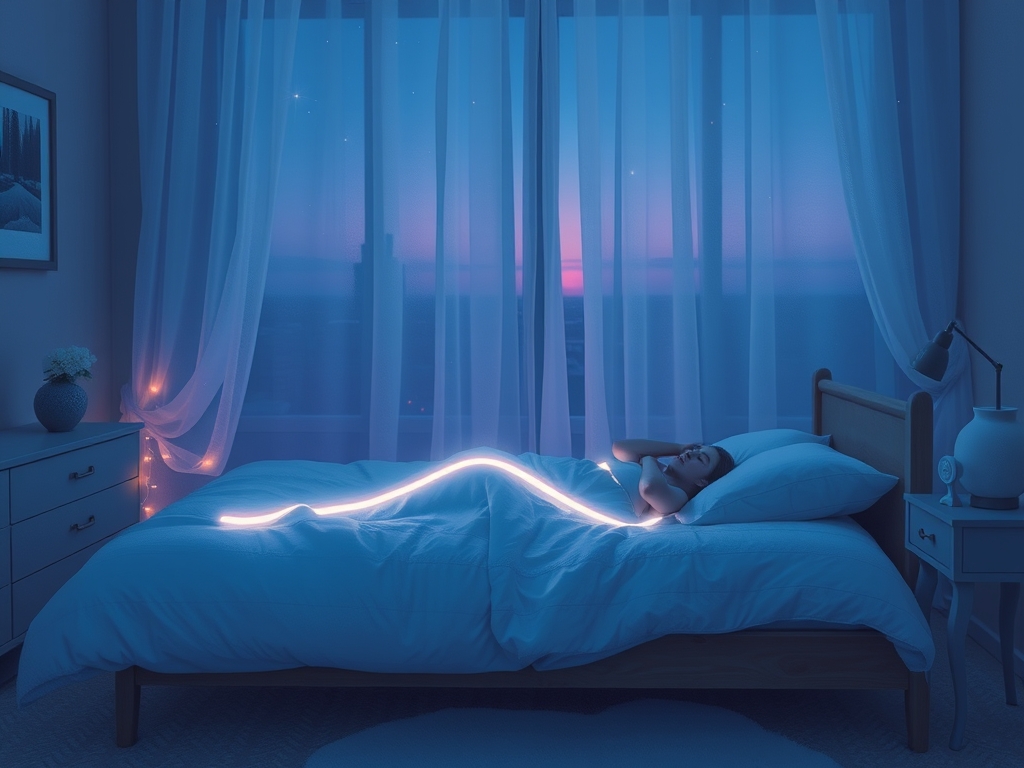
For three years, falling asleep took me between forty minutes and two hours. I’d lie in bed, eyes closed, mind spinning, body tense, increasingly frustrated by my inability to do the one thing that should be the easiest thing in the world: let go.
I tried melatonin. I tried white noise machines. I tried every sleep hygiene tip on the internet. Some helped marginally. None solved the problem.
What finally solved it was a body scan meditation so simple that I dismissed it three times before actually committing to it.
The Practice
I’m going to describe exactly what I do, because the specifics matter more than the general concept.
I lie in bed, on my back, in whatever position I’ll eventually sleep in (usually on my side, but I start on my back). I close my eyes. I take three deep breaths, not counted or timed, just three slow, deliberate breaths to signal to my body that the day is over.
Then I begin at my feet.
I bring my attention, my full, gentle attention, to my left foot. Not thinking about my foot. Feeling my foot. The weight of it on the mattress. The temperature of the skin. The sensation in each toe. I spend about fifteen seconds there, just feeling.
Then I silently say to my left foot: “Thank you. You can rest now.”
I move to my right foot. Same thing. Feeling. Presence. “Thank you. You can rest now.”
Then my left ankle. My right ankle. Left calf. Right calf. Left knee. Right knee. And so on, moving upward through every part of my body: thighs, hips, lower back, abdomen, chest, shoulders, upper arms, forearms, hands, fingers, neck, jaw, cheeks, eyes, forehead, scalp.
At each stop, I feel the body part fully and then release it with gratitude.
Why It Works
The reason this works, and I’ve looked into the neuroscience enough to understand the mechanism, is that insomnia is largely driven by a nervous system stuck in sympathetic (fight-or-flight) mode. Your body is physically prepared for action: muscles tensed, heart rate elevated, cortisol flowing. This state is incompatible with sleep.
The body scan systematically deactivates the sympathetic nervous system. By bringing gentle attention to each body part and consciously releasing it, you’re activating the parasympathetic (rest-and-digest) response. You’re telling your nervous system, one body part at a time: the danger is over. You can stand down.
The gratitude element isn’t just spiritual window dressing. Gratitude triggers a specific neurochemical response (involving oxytocin and serotonin) that actively counters the cortisol-driven stress response. When you say “thank you” to your tired feet and genuinely feel a moment of appreciation for what they did today, your brain chemistry shifts toward calm.
What I’ve Noticed Over Time
When I first started this practice, I’d make it through the entire body scan (about fifteen to twenty minutes) and then lie awake for another ten or fifteen minutes before sleep came. That was still a dramatic improvement over my previous forty-to-120-minute ordeal.
Within two weeks, I was falling asleep during the scan. Often somewhere around the torso. I’d be feeling my ribcage, saying “thank you, you can rest now,” and then it would be morning. My body had learned the routine and started anticipating sleep earlier and earlier in the process.
Now, six months in, I rarely make it past my knees. My body hears the opening cue (three deep breaths, attention to the left foot) and immediately begins downshifting. The neural pathway from “body scan” to “sleep” is now well-worn and reliable.
Variations I’ve Tried
The warmth variation: Instead of just feeling each body part, I imagine warmth spreading into it. As if a gentle, golden warmth is flowing into my left foot, relaxing every muscle fiber. This works especially well in winter, when my body is cold and tense.
The heaviness variation: At each body part, I imagine it becoming heavy. Sinking into the mattress. This is similar to the classic autogenic training technique and works well for people who carry a lot of physical tension.
The light variation: I imagine each body part filling with soft light as I bring attention to it. By the time I reach the top of my head, my whole body is glowing (in my imagination). This variation has a slightly more uplifting quality and works well when I’m feeling anxious rather than just tense.
The Deeper Dimension
While this practice started as a sleep tool, it’s become something more. The nightly body scan has made me significantly more aware of my body during the day. I notice tension forming in my shoulders before it becomes a headache. I notice my jaw clenching before it becomes pain. I notice my stomach tightening in response to stress before it becomes nausea.
This body awareness has practical value beyond sleep. It’s an early warning system for stress, allowing me to intervene before stress escalates into physical symptoms. In a sense, the body scan taught me to listen to my body, and the body, it turns out, has a lot to say.
There’s also a meditative quality to this practice that has surprised me. The sustained attention to physical sensation, without judgment, without trying to change anything, just pure awareness, is essentially mindfulness meditation applied to the body. Some of my deepest insights and most peaceful moments have come not during formal meditation but during the body scan, in that liminal space between waking and sleeping.
How to Start Tonight
Here’s the minimal version you can try tonight:
Lie down. Three deep breaths.
Start at your feet. Feel them. Say “you can rest now.”
Move upward slowly. Feel each part. Release each part.
Don’t rush. Don’t skip areas. The thoroughness is part of what makes it work.
If your mind wanders, gently bring it back to wherever you were in the body.
If you fall asleep mid-scan, that’s not failure. That’s the goal.
Give it a week of nightly practice before evaluating. The first night or two might feel awkward or incomplete. By night three or four, your body will start to recognize the pattern. By the end of the week, you’ll likely notice a real difference in how quickly and deeply you fall asleep.
The body wants to rest. It’s designed for rest. Usually, what keeps it from resting is a mind that won’t stop and a nervous system that won’t stand down. The body scan addresses both, gently, progressively, and without any pills, supplements, or equipment.
Just attention. Just gratitude. Just one body part at a time, from feet to crown, until sleep takes you.