The Morning Pain Woke Me Up, Literally and Otherwise
A few years ago, I went through a stretch of chronic back pain that resisted every treatment I tried. Physical therapy helped some. Medication dulled it. But every morning, there it was, this deep, stubborn ache that colored my entire day. I was frustrated, irritable, and increasingly desperate.
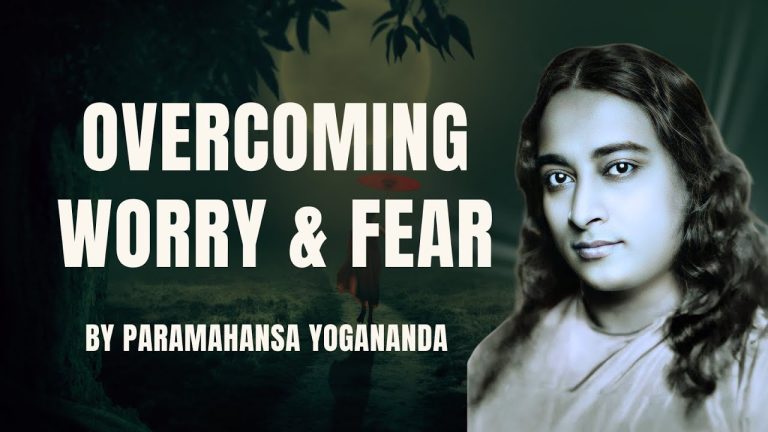
It was during that period that I came across a line from Paramahansa Yogananda that reframed everything I thought I understood about pain. He didn’t offer a cure. He offered something stranger and more useful: a reason.
“Pain is a prod to remembrance. God is the only cure, because God is the only disease, the disease of forgetfulness.”
– Paramahansa Yogananda (1975), “Why God Created the World”
I sat with that line for a long time. At first, it annoyed me. I didn’t want a spiritual reframe, I wanted my back to stop hurting. But the more I returned to it, the more I realized Yogananda wasn’t dismissing pain. He was revealing its hidden function.
What Yogananda Meant by “Remembrance”
In Yogananda’s framework, human beings are souls who have temporarily forgotten their true nature. We’re divine consciousness, infinite, blissful, free, wearing the costume of a limited human body with a name, an address, and a collection of problems. The forgetting is so complete that we genuinely believe we are the costume.
Pain, in this view, is a signal. Not a punishment. Not random cruelty. A signal that something has drifted far from alignment with truth. The way a fever signals infection, pain signals forgetting. And what we’ve forgotten, according to Yogananda, is that our deepest identity is spirit, not flesh.
This doesn’t mean pain is imaginary or that you should grin through it. Yogananda himself sought medical treatment when needed. He wasn’t anti-medicine. He was pro-understanding. He wanted people to address pain on every level, physical, mental, and spiritual, rather than treating only the body while ignoring the soul’s message.
The Two Kinds of Forgetting
I’ve come to see two layers in what Yogananda calls “forgetting.” The first is cosmic: the soul’s immersion in matter, the grand drama of consciousness losing itself in form. That’s the philosophical level.
But there’s a practical level too. We forget the things that actually sustain us. We forget to meditate, to be still, to connect with something larger than our daily anxieties. We forget that we have an inner life at all. We get so absorbed in doing, in producing, achieving, worrying, that we lose contact with being.
Pain interrupts the doing. Sometimes violently. And in that interruption, if we’re willing to look, there’s an opening.
My Own “Prod to Remembrance”
I’m not going to romanticize my back pain. It was awful. I was sleep-deprived, short-tempered, and genuinely scared it would never improve. But I can say, honestly and without spiritual embellishment, that it changed the direction of my life.
Before the pain, my meditation practice was sporadic at best. I’d sit for ten minutes when I remembered, which was maybe twice a week. I was too busy, too productive, too caught up in the momentum of doing to prioritize stillness.
The pain forced me to slow down. I couldn’t work twelve-hour days anymore. I couldn’t distract myself with activity. I was stuck with myself, with the quiet, with the discomfort, with the questions I’d been outrunning for years. And in that involuntary stillness, I started meditating consistently. Not because I was disciplined, but because I had nothing else left to try.
“Suffering is a good teacher to those who are quick and willing to learn from it. But it becomes a tyrant to those who resist.”
– Paramahansa Yogananda (1952)
That quote described my experience precisely. The months I spent resisting the pain, fighting it, cursing it, demanding it leave, were the worst months. When I finally stopped resisting and started listening, something shifted. Not the pain itself, necessarily, but my relationship to it.
Pain as a Doorway, Not a Wall
Here’s the paradigm shift Yogananda offers: most of us treat pain as an obstacle to life. Something that gets in the way of what we really want to be doing. And on a practical level, that’s often true, pain limits us, frustrates us, exhausts us.
But Yogananda suggests that pain can also be a doorway, one that opens specifically because the walls of our comfortable routine have been broken. When everything is going well, we rarely ask deep questions. We rarely turn inward. We rarely remember the spiritual dimension of existence. It’s only when something disrupts the smooth surface of life that we’re forced to look beneath it.
This isn’t a justification of suffering. Yogananda didn’t teach that God deliberately inflicts pain to teach lessons. He taught that pain is an inherent feature of a material world built on duality, pleasure and pain, gain and loss, birth and death, and that the wise soul uses pain as a catalyst rather than merely enduring it.
The Difference Between Suffering and Learning
I think the key distinction is between suffering passively and engaging pain actively. Passive suffering is just endurance, gritting your teeth and waiting for it to pass. Active engagement means asking: What is this pain revealing? What have I been neglecting? What does this interruption make possible that my busy life didn’t?
For me, the answers were humbling. I’d been neglecting my inner life. I’d been treating my body like a machine. I’d been running from stillness because stillness meant facing feelings I wasn’t ready for. The pain made all of that impossible to ignore.
Exercise: Sitting with Pain as a Teacher
This is a contemplative practice I developed from Yogananda’s teachings. It’s not a pain-relief technique (though it sometimes eases things). It’s a way of changing your relationship to pain so it becomes informative rather than purely adversarial.
Step 1: Sit comfortably, or as comfortably as you can. If you’re in physical pain, find the position that causes the least aggravation. Close your eyes and take several slow breaths.
Step 2: Instead of trying to ignore the pain or push it away, gently direct your attention toward it. Not with aggression, but with curiosity. Where exactly is it? What is its quality, sharp, dull, burning, aching? Does it stay still or move?
Step 3: Silently ask the pain: What are you trying to tell me? Don’t force an answer. Just sit with the question and notice what arises, a memory, an emotion, an intuition, a word. Trust whatever comes, even if it seems unrelated.
Step 4: Now expand your awareness beyond the pain. Feel the parts of your body that aren’t in pain. Notice the breath moving in and out. Recognize that you are the awareness holding the pain, you are not the pain itself. This is the core of what Yogananda means by remembrance: you remember that you are the consciousness in which pain appears, not the pain.
Step 5: Close with a simple inner statement: “I am spirit. This pain is temporary. The awareness experiencing it is eternal.” Sit with that for a minute before opening your eyes.
When the Pain Doesn’t Go Away
I want to be honest about something. My back pain did eventually improve, through a combination of physical therapy, lifestyle changes, and yes, the inner work. But there are people reading this whose pain won’t improve. Chronic conditions, terminal diagnoses, losses that can’t be reversed.
Yogananda’s teaching still applies, but it takes on a more sober tone. When pain is permanent, the “prod to remembrance” isn’t about fixing the problem. It’s about discovering something unbreakable within yourself, something the pain can’t touch because it exists on a different level entirely.
I’ve spoken with people who’ve found profound peace in the midst of incurable illness. Not because they denied their condition, but because the condition drove them so deep into spiritual practice that they found a stillness beneath the suffering. Yogananda would say they found what the pain was always pointing toward: the Self that doesn’t suffer, the consciousness that holds everything without being damaged by anything.
The Remembrance That Changes Everything
Pain is real. I don’t minimize it. But I’ve come to believe, through lived experience, not just philosophy, that it carries information we rarely pause to receive. Yogananda’s teaching gave me permission to stop fighting and start listening. And what I heard, eventually, was a quiet invitation to remember something I’d been too busy and too comfortable to notice:
I am more than this body. I am more than this circumstance. And the very pain that seemed to diminish my life was actually calling me back to the immensity of what I truly am.
That’s the prod. That’s the remembrance. It doesn’t erase the pain. But it places it in a context so vast that the pain, while still present, is no longer the whole story.